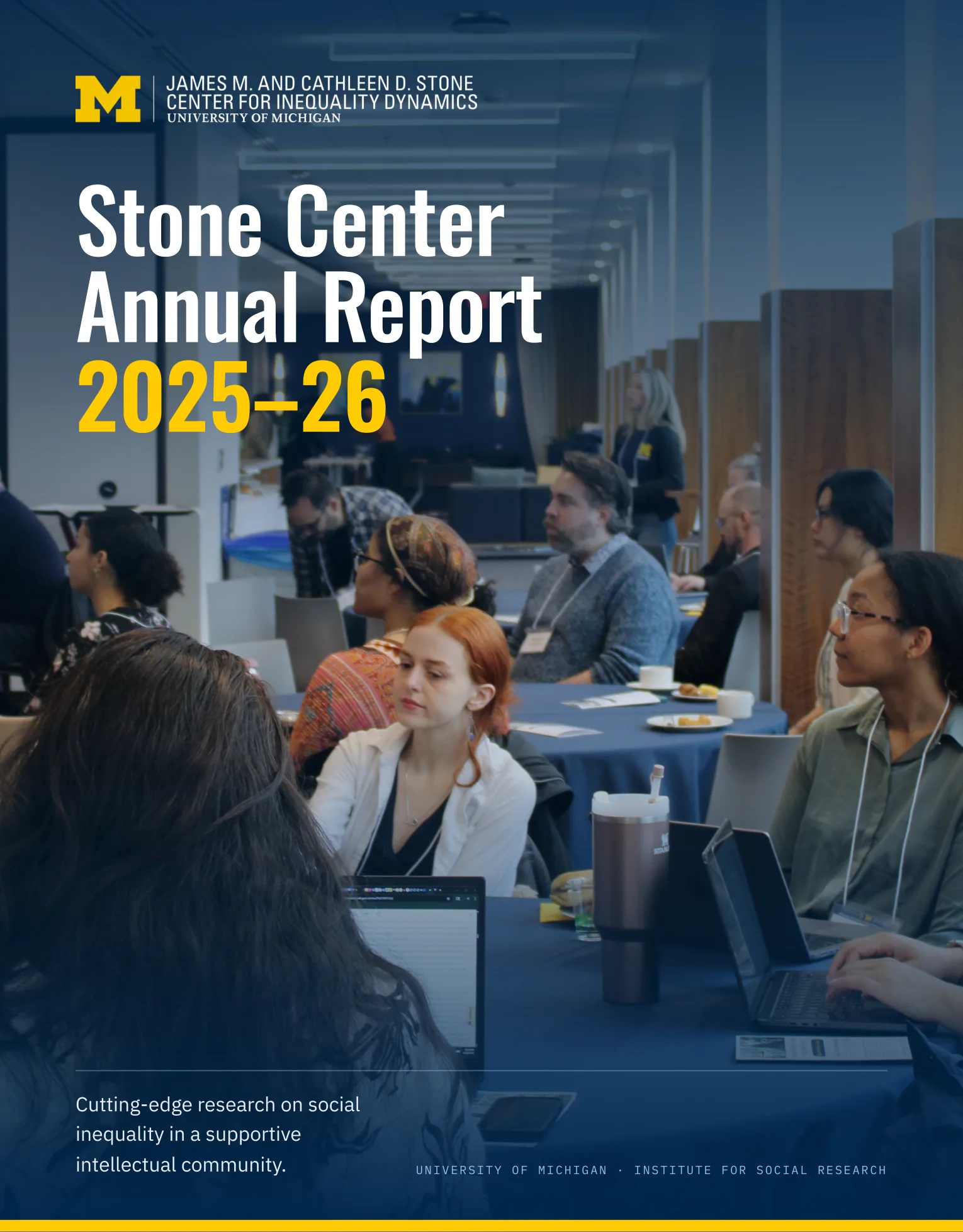
Stone Center
Annual Report
2025–26
Cutting-edge research on social
inequality in a supportive
intellectual community.
UNIVERSITY OF MICHIGAN · INSTITUTE FOR SOCIAL RESEARCH
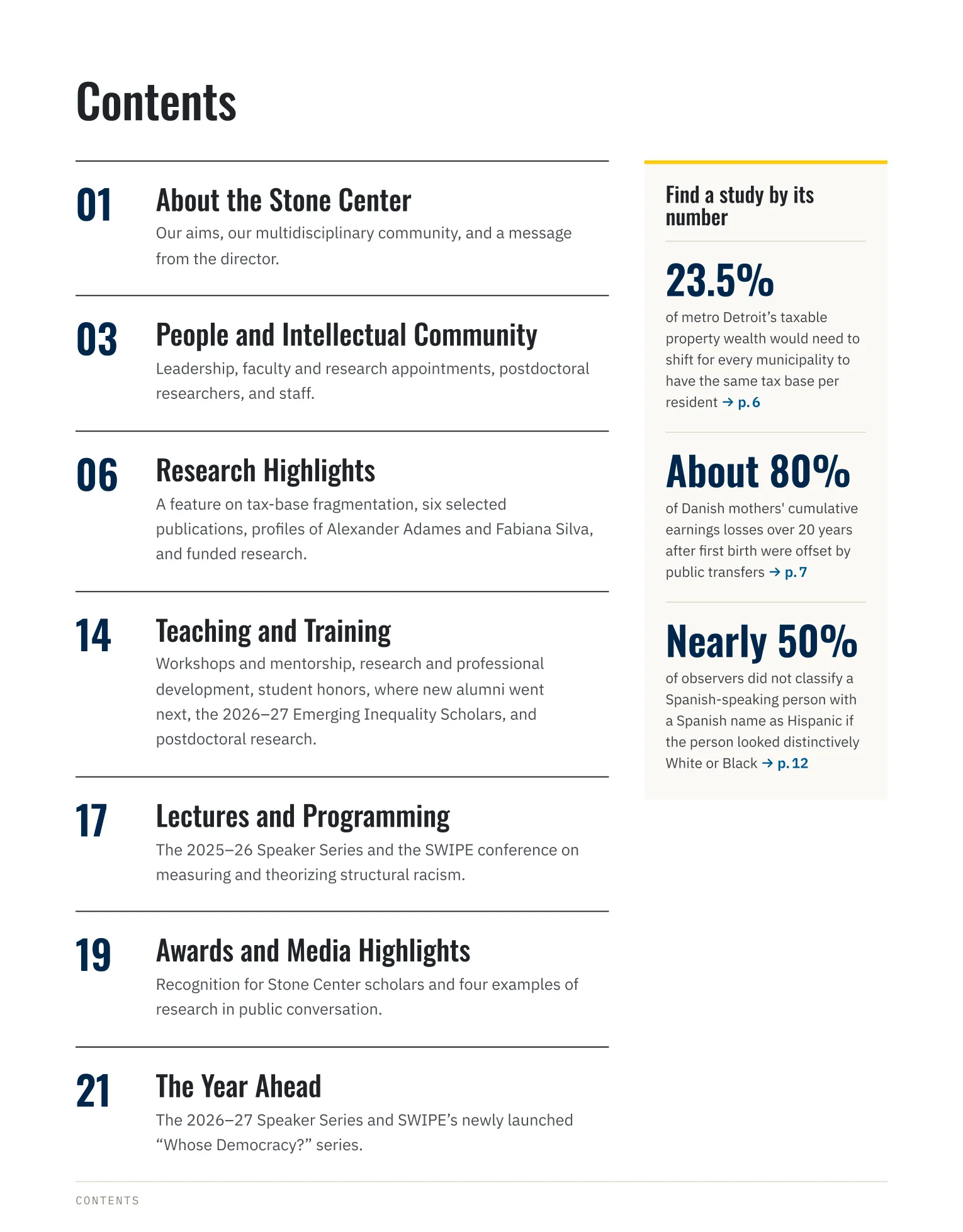
Contents
01
About the Stone Center
Our aims, our multidisciplinary community, and a message
from the director.
03
People and Intellectual Community
Leadership, faculty and research appointments, postdoctoral
researchers, and staff.
06
Research Highlights
A feature on tax-base fragmentation, six selected
publications, profiles of Alexander Adames and Fabiana Silva,
and funded research.
14
Teaching and Training
Workshops and mentorship, research and professional
development, student honors, where new alumni went
next, the 2026–27 Emerging Inequality Scholars, and
postdoctoral research.
17
Lectures and Programming
The 2025–26 Speaker Series and the SWIPE conference on
measuring and theorizing structural racism.
19
Awards and Media Highlights
Recognition for Stone Center scholars and four examples of
research in public conversation.
21
The Year Ahead
The 2026–27 Speaker Series and SWIPE’s newly launched
“Whose Democracy?” series.
Find a study by its
number
23.5%
of metro Detroit’s taxable
property wealth would need to
shift for every municipality to
have the same tax base per
resident → p. 6
About 80%
of Danish mothers' cumulative
earnings losses over 20 years
after first birth were offset by
public transfers → p. 7
Nearly 50%
of observers did not classify a
Spanish-speaking person with
a Spanish name as Hispanic if
the person looked distinctively
White or Black → p. 12
CONTENTS
About the Stone Center
The Stone Center for Inequality Dynamics (CID) at the University of Michigan
Institute for Social Research (ISR) aims to:
1
Produce cutting-edge research on social inequality,
especially wealth inequality
2
Train the next generation of inequality scholars
3
Build a robust intellectual community
We pursue these aims as an interdisciplinary group of social scientists working in a collaborative
space. Our team includes experts on topics such as wealth and income inequality, economic
mobility, economic sociology, and housing. Together, we examine how between-group inequalities
are shaped by geographic, political, and institutional contexts.
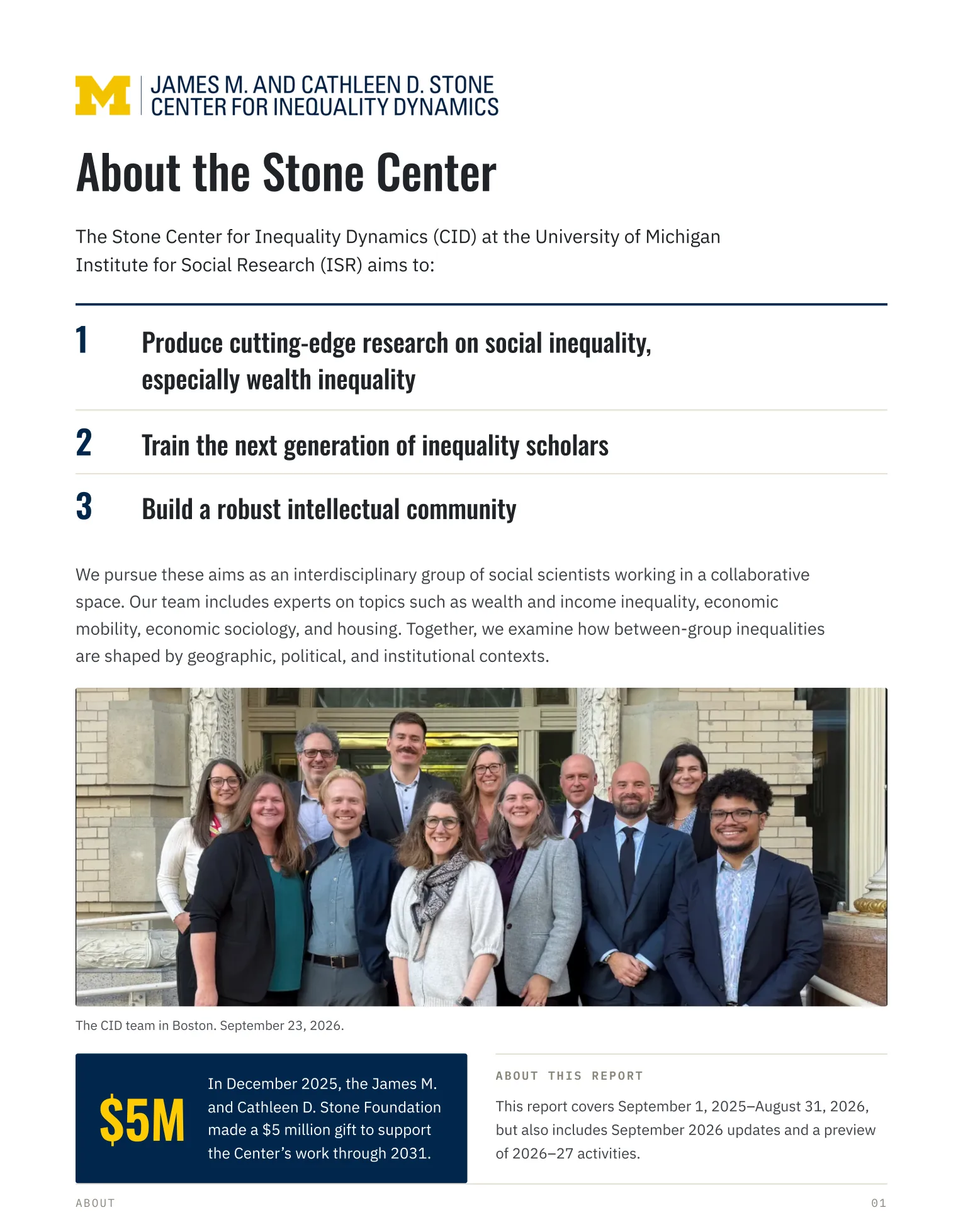
The CID team in Boston. September 23, 2026.
$5M
In December 2025, the James M.
and Cathleen D. Stone Foundation
made a $5 million gift to support
the Center’s work through 2031.
ABOUT THIS REPORT
This report covers September 1, 2025–August 31, 2026,
but also includes September 2026 updates and a preview
of 2026–27 activities.
ABOUT
01
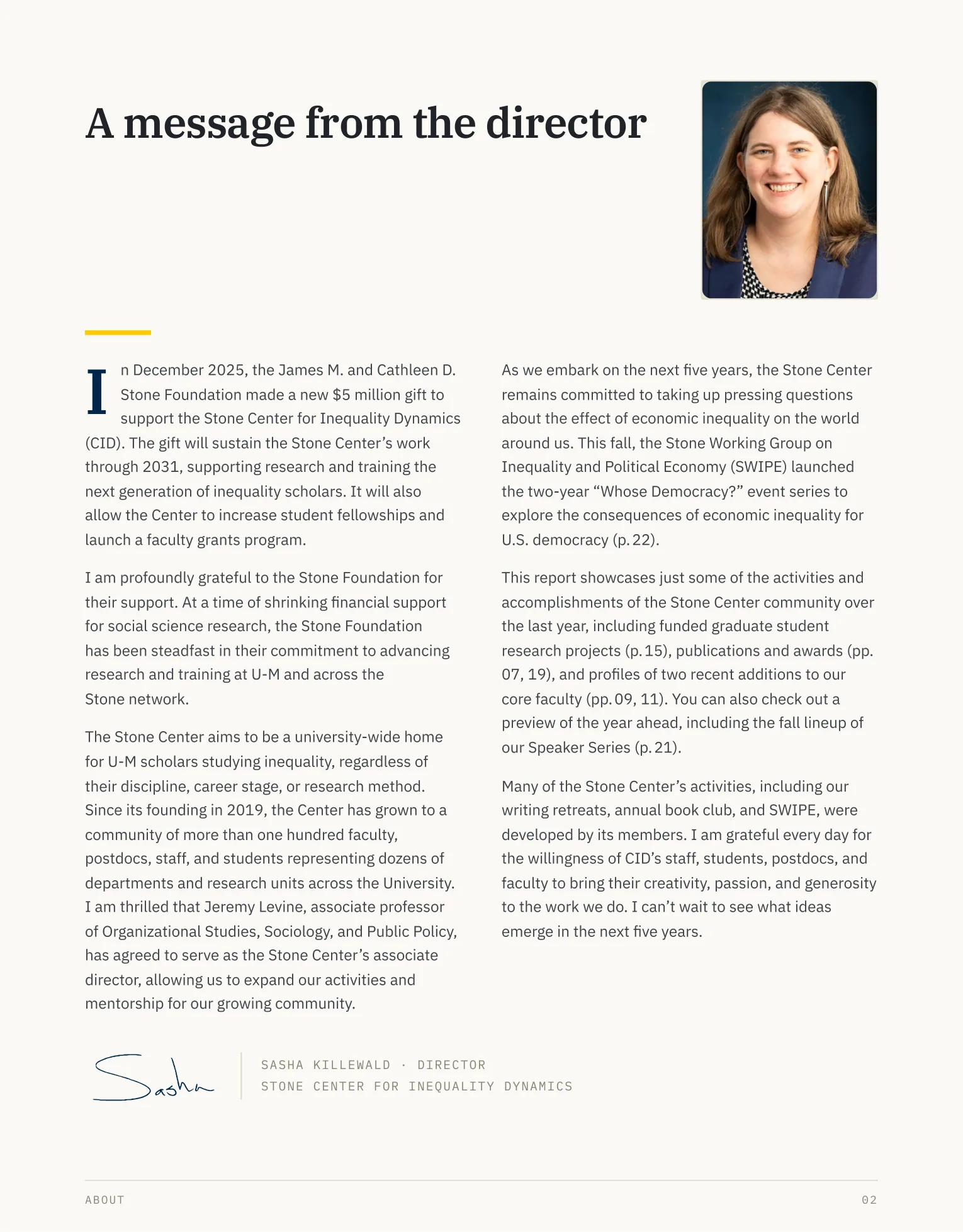
A message from the director
I
n December 2025, the James M. and Cathleen D.
Stone Foundation made a new $5 million gift to
support the Stone Center for Inequality Dynamics
(CID). The gift will sustain the Stone Center’s work
through 2031, supporting research and training the
next generation of inequality scholars. It will also
allow the Center to increase student fellowships and
launch a faculty grants program.
I am profoundly grateful to the Stone Foundation for
their support. At a time of shrinking financial support
for social science research, the Stone Foundation
has been steadfast in their commitment to advancing
research and training at U-M and across the
Stone network.
The Stone Center aims to be a university-wide home
for U-M scholars studying inequality, regardless of
their discipline, career stage, or research method.
Since its founding in 2019, the Center has grown to a
community of more than one hundred faculty,
postdocs, staff, and students representing dozens of
departments and research units across the University.
I am thrilled that Jeremy Levine, associate professor
of Organizational Studies, Sociology, and Public Policy,
has agreed to serve as the Stone Center’s associate
director, allowing us to expand our activities and
mentorship for our growing community.
As we embark on the next five years, the Stone Center
remains committed to taking up pressing questions
about the effect of economic inequality on the world
around us. This fall, the Stone Working Group on
Inequality and Political Economy (SWIPE) launched
the two-year “Whose Democracy?” event series to
explore the consequences of economic inequality for
U.S. democracy (p. 22).
This report showcases just some of the activities and
accomplishments of the Stone Center community over
the last year, including funded graduate student
research projects (p. 15), publications and awards (pp.
07, 19), and profiles of two recent additions to our
core faculty (pp. 09, 11). You can also check out a
preview of the year ahead, including the fall lineup of
our Speaker Series (p. 21).
Many of the Stone Center’s activities, including our
writing retreats, annual book club, and SWIPE, were
developed by its members. I am grateful every day for
the willingness of CID’s staff, students, postdocs, and
faculty to bring their creativity, passion, and generosity
to the work we do. I can’t wait to see what ideas
emerge in the next five years.
SASHA KILLEWALD · DIRECTOR
STONE CENTER FOR INEQUALITY DYNAMICS
ABOUT
02
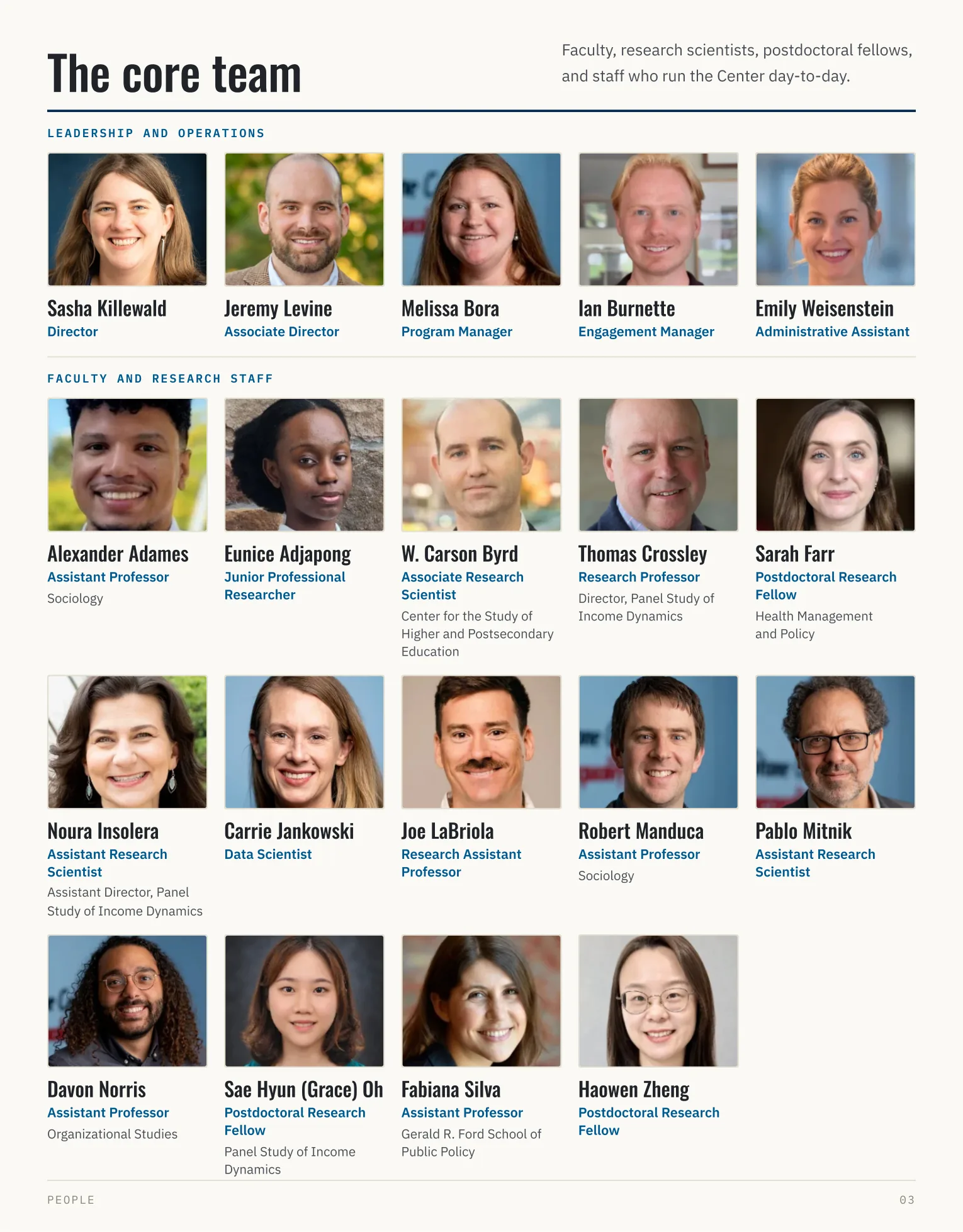
The core team
Faculty, research scientists, postdoctoral fellows,
and staff who run the Center day-to-day.
LEADERSHIP AND OPERATIONS
Sasha Killewald
Director
Jeremy Levine
Associate Director
Melissa Bora
Program Manager
Ian Burnette
Engagement Manager
Emily Weisenstein
Administrative Assistant
FACULTY AND RESEARCH STAFF
Alexander Adames
Assistant Professor
Sociology
Eunice Adjapong
Junior Professional
Researcher
W. Carson Byrd
Associate Research
Scientist
Center for the Study of
Higher and Postsecondary
Education
Thomas Crossley
Research Professor
Director, Panel Study of
Income Dynamics
Sarah Farr
Postdoctoral Research
Fellow
Health Management
and Policy
Noura Insolera
Assistant Research
Scientist
Assistant Director, Panel
Study of Income Dynamics
Carrie Jankowski
Data Scientist
Joe LaBriola
Research Assistant
Professor
Robert Manduca
Assistant Professor
Sociology
Pablo Mitnik
Assistant Research
Scientist
Davon Norris
Assistant Professor
Organizational Studies
Sae Hyun (Grace) Oh
Postdoctoral Research
Fellow
Panel Study of Income
Dynamics
Fabiana Silva
Assistant Professor
Gerald R. Ford School of
Public Policy
Haowen Zheng
Postdoctoral Research
Fellow
PEOPLE
03
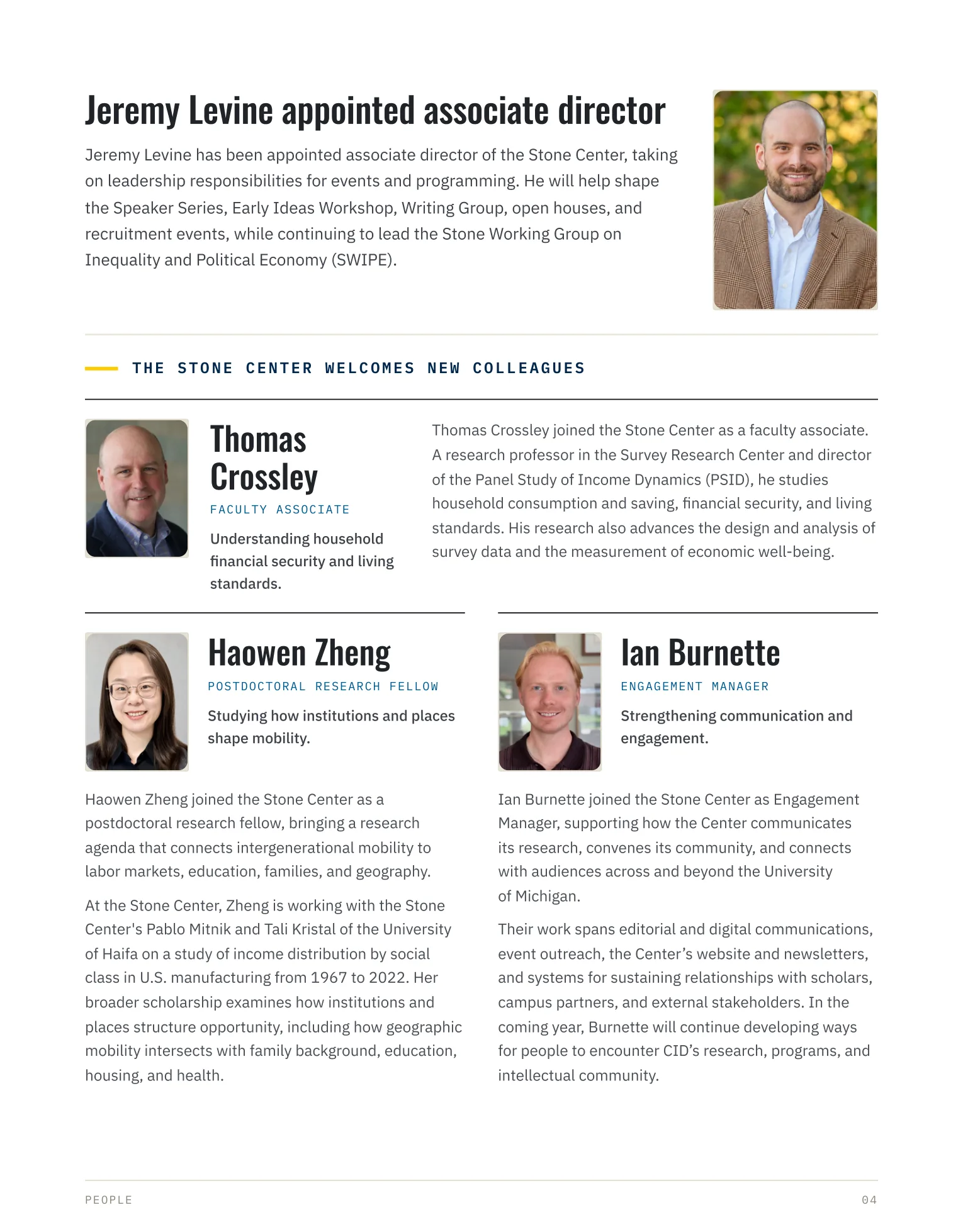
Jeremy Levine appointed associate director
Jeremy Levine has been appointed associate director of the Stone Center, taking
on leadership responsibilities for events and programming. He will help shape
the Speaker Series, Early Ideas Workshop, Writing Group, open houses, and
recruitment events, while continuing to lead the Stone Working Group on
Inequality and Political Economy (SWIPE).
THE STONE CENTER WELCOMES NEW COLLEAGUES
Thomas
Crossley
FACULTY ASSOCIATE
Understanding household
financial security and living
standards.
Thomas Crossley joined the Stone Center as a faculty associate.
A research professor in the Survey Research Center and director
of the Panel Study of Income Dynamics (PSID), he studies
household consumption and saving, financial security, and living
standards. His research also advances the design and analysis of
survey data and the measurement of economic well-being.
Haowen Zheng
POSTDOCTORAL RESEARCH FELLOW
Studying how institutions and places
shape mobility.
Haowen Zheng joined the Stone Center as a
postdoctoral research fellow, bringing a research
agenda that connects intergenerational mobility to
labor markets, education, families, and geography.
At the Stone Center, Zheng is working with the Stone
Center's Pablo Mitnik and Tali Kristal of the University
of Haifa on a study of income distribution by social
class in U.S. manufacturing from 1967 to 2022. Her
broader scholarship examines how institutions and
places structure opportunity, including how geographic
mobility intersects with family background, education,
housing, and health.
Ian Burnette
ENGAGEMENT MANAGER
Strengthening communication and
engagement.
Ian Burnette joined the Stone Center as Engagement
Manager, supporting how the Center communicates
its research, convenes its community, and connects
with audiences across and beyond the University
of Michigan.
Their work spans editorial and digital communications,
event outreach, the Center’s website and newsletters,
and systems for sustaining relationships with scholars,
campus partners, and external stakeholders. In the
coming year, Burnette will continue developing ways
for people to encounter CID’s research, programs, and
intellectual community.
PEOPLE
04
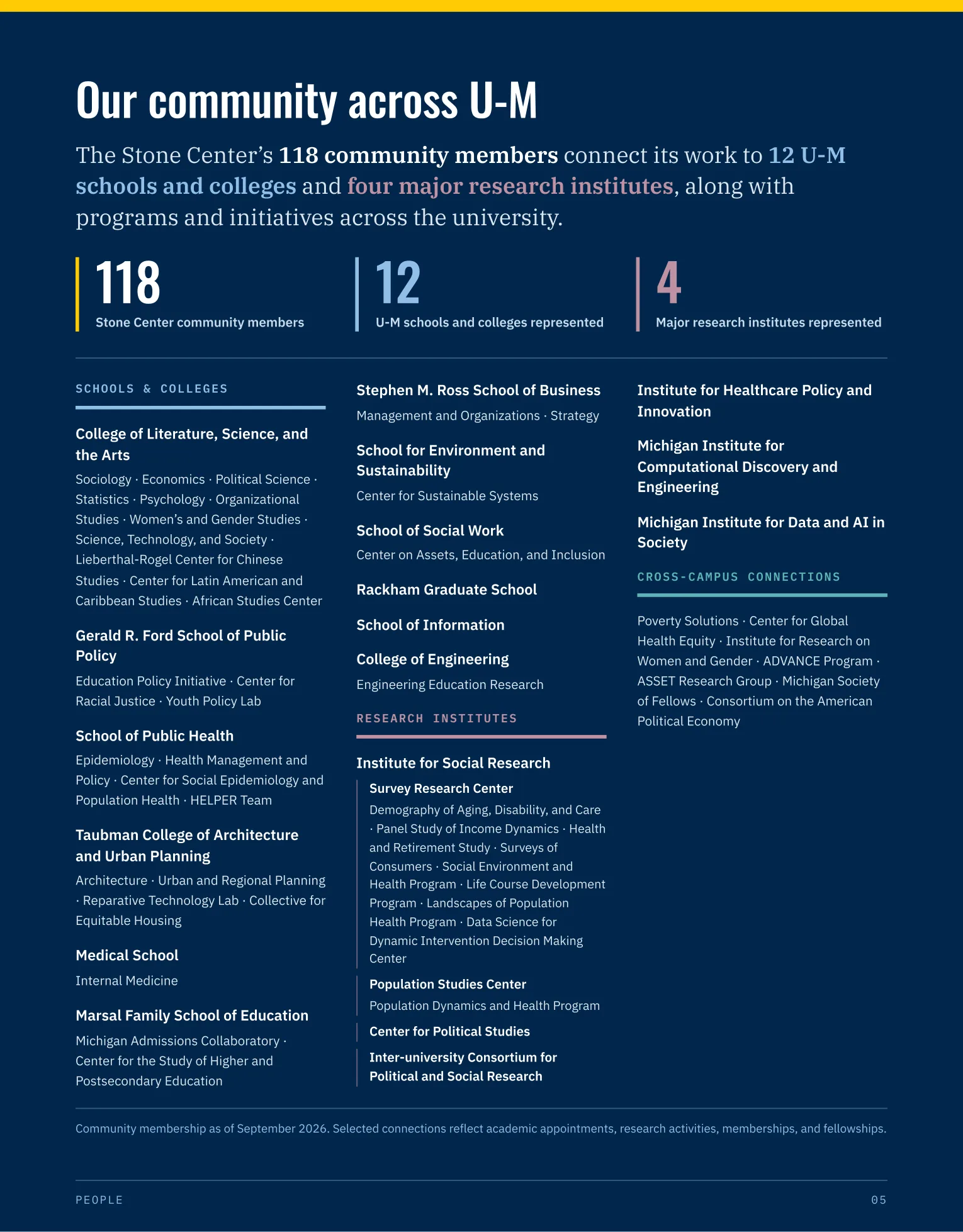
Our community across U-M
The Stone Center’s 118 community members connect its work to 12 U-M
schools and colleges and four major research institutes, along with
programs and initiatives across the university.
118
Stone Center community members
12
U-M schools and colleges represented
4
Major research institutes represented
SCHOOLS & COLLEGES
College of Literature, Science, and
the Arts
Sociology · Economics · Political Science ·
Statistics · Psychology · Organizational
Studies · Women’s and Gender Studies ·
Science, Technology, and Society ·
Lieberthal-Rogel Center for Chinese
Studies · Center for Latin American and
Caribbean Studies · African Studies Center
Gerald R. Ford School of Public
Policy
Education Policy Initiative · Center for
Racial Justice · Youth Policy Lab
School of Public Health
Epidemiology · Health Management and
Policy · Center for Social Epidemiology and
Population Health · HELPER Team
Taubman College of Architecture
and Urban Planning
Architecture · Urban and Regional Planning
· Reparative Technology Lab · Collective for
Equitable Housing
Medical School
Internal Medicine
Marsal Family School of Education
Michigan Admissions Collaboratory ·
Center for the Study of Higher and
Postsecondary Education
Stephen M. Ross School of Business
Management and Organizations · Strategy
School for Environment and
Sustainability
Center for Sustainable Systems
School of Social Work
Center on Assets, Education, and Inclusion
Rackham Graduate School
School of Information
College of Engineering
Engineering Education Research
RESEARCH INSTITUTES
Institute for Social Research
Survey Research Center
Demography of Aging, Disability, and Care
· Panel Study of Income Dynamics · Health
and Retirement Study · Surveys of
Consumers · Social Environment and
Health Program · Life Course Development
Program · Landscapes of Population
Health Program · Data Science for
Dynamic Intervention Decision Making
Center
Population Studies Center
Population Dynamics and Health Program
Center for Political Studies
Inter-university Consortium for
Political and Social Research
Institute for Healthcare Policy and
Innovation
Michigan Institute for
Computational Discovery and
Engineering
Michigan Institute for Data and AI in
Society
CROSS-CAMPUS CONNECTIONS
Poverty Solutions · Center for Global
Health Equity · Institute for Research on
Women and Gender · ADVANCE Program ·
ASSET Research Group · Michigan Society
of Fellows · Consortium on the American
Political Economy
Community membership as of September 2026. Selected connections reflect academic appointments, research activities, memberships, and fellowships.
PEOPLE
05
RESEARCH HIGHLIGHT
How municipal boundaries
divide taxable wealth
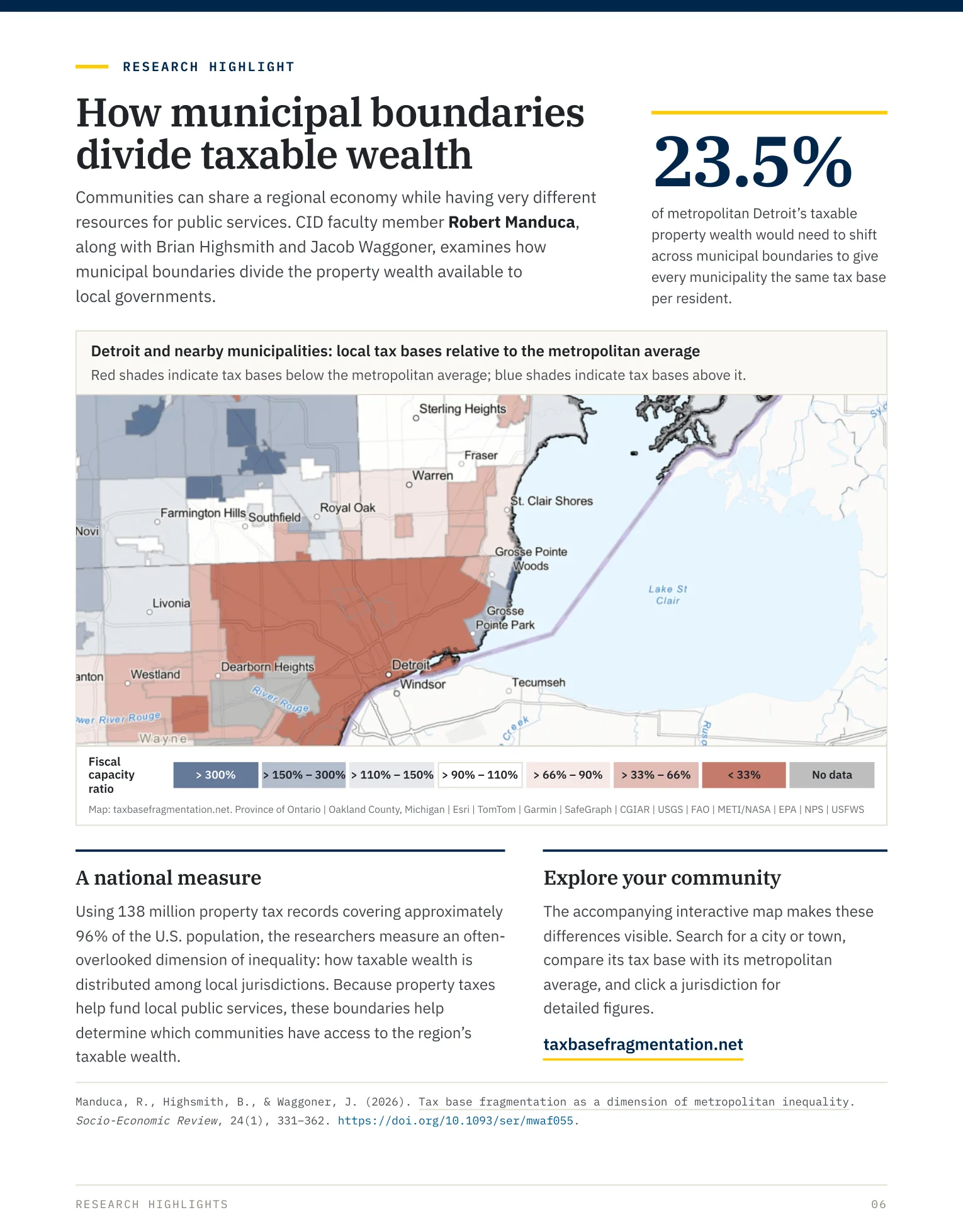
Communities can share a regional economy while having very different
resources for public services. CID faculty member Robert Manduca,
along with Brian Highsmith and Jacob Waggoner, examines how
municipal boundaries divide the property wealth available to
local governments.
23.5%
of metropolitan Detroit’s taxable
property wealth would need to shift
across municipal boundaries to give
every municipality the same tax base
per resident.
Detroit and nearby municipalities: local tax bases relative to the metropolitan average
Red shades indicate tax bases below the metropolitan average; blue shades indicate tax bases above it.
Fiscal
capacity
ratio
> 300%
> 150% – 300% > 110% – 150% > 90% – 110%
> 66% – 90%
> 33% – 66%
< 33%
No data
Map: taxbasefragmentation.net. Province of Ontario | Oakland County, Michigan | Esri | TomTom | Garmin | SafeGraph | CGIAR | USGS | FAO | METI/NASA | EPA | NPS | USFWS
A national measure
Using 138 million property tax records covering approximately
96% of the U.S. population, the researchers measure an often-
overlooked dimension of inequality: how taxable wealth is
distributed among local jurisdictions. Because property taxes
help fund local public services, these boundaries help
determine which communities have access to the region’s
taxable wealth.
Explore your community
The accompanying interactive map makes these
differences visible. Search for a city or town,
compare its tax base with its metropolitan
average, and click a jurisdiction for
detailed figures.
taxbasefragmentation.net
Manduca, R., Highsmith, B., & Waggoner, J. (2026). Tax base fragmentation as a dimension of metropolitan inequality.
Socio-Economic Review, 24(1), 331–362. https://doi.org/10.1093/ser/mwaf055.
RESEARCH HIGHLIGHTS
06
RESEARCH HIGHLIGHTS
Selected Publications
Social insurance and
the definition of wealth
Robert Manduca · Assistant Professor
Measures of wealth typically emphasize
marketable assets. Manduca asks whether
pensions and social insurance should also count
when they provide many of the same functions.
Because this “augmented wealth” often exceeds
marketable wealth in total value and is
distributed more evenly, the definition can alter
basic conclusions about wealth inequality. He
argues for use-specific definitions: identify the
function of wealth relevant to a study, then
include all assets available for that use.
Manduca, R. (2025). Should social insurance programs count as
wealth? Socio-Economic Review, 23(4), 1863–1893.
doi:10.1093/ser/mwaf020.
Public transfers and the
motherhood income penalty
Alexandra Killewald · Director
Therese Bay-Smidt Christensen and Alexandra
Killewald use Danish register data to examine
how motherhood affects income from
employment and the state. Over two decades
after first birth, about $98,000 in additional
public transfers offset roughly 80% of an
estimated $120,000 in cumulative labor-income
losses. The study estimates the resulting
cumulative loss in personal income at about
$23,000. The findings show that governments,
when they choose to, can substantially reduce
the income costs of motherhood.
Christensen, T. B.-S., & Killewald, A. (2026). Can a motherhood
premium in public transfer income offset the Danish motherhood
earnings penalty? European Sociological Review, 42(4), 573–589.
doi:10.1093/esr/jcaf036.
Safety-net support
and household credit
Davon Norris · Assistant Professor
Davon Norris and coauthors examine how state
safety nets relate to households’ use of
unsecured credit. More supportive state safety
nets are associated with less use of high-cost
payday, installment, and personal-finance loans
and greater access to mainstream credit cards,
especially among low-income households.
The findings link state safety-net support to
the credit options households use to manage
financial shortfalls.
Rhodes, A. P., Norris, D., Houle, J., Dwyer, R. E., Bruch, S. K., &
Berger, L. M. (2026). Unsecured credit and the social safety net in
U.S. states. American Sociological Review, 91(2), 349–377.
doi:10.1177/00031224251411563.
RESEARCH HIGHLIGHTS
07
RESEARCH HIGHLIGHTS
Selected Publications, continued
Racism and the mechanisms
of educational inequality
W. Carson Byrd · Associate Research Scientist
David Rangel and W. Carson Byrd propose that
education researchers draw on fundamental
cause theory to sharpen explanations of racial
inequality. Developed in medical sociology, the
framework asks whether a durable social cause
keeps reproducing unequal outcomes through
changing mechanisms and flexible resources. The
authors argue it can help researchers specify how
racism produces educational disparities rather
than treating race as a standalone variable.
Rangel, D. E., & Byrd, W. C. (2026). Toward clarifying mechanisms
of racism as fundamental causes of educational inequality.
Educational Researcher, 55(1), 46–54.
doi:10.3102/0013189X251356448.
VOL. 13
2026
College, selection, and
intergenerational mobility
Haowen Zheng · Postdoctoral Research Fellow
Haowen Zheng and coauthors revisit the claim
that college equalizes labor-market outcomes
across family backgrounds. Using an
instrumental-variable approach with White male
respondents in the 1979 National Longitudinal
Survey of Youth, they account for unobserved
selection into college. After this adjustment,
intergenerational mobility is similar among
graduates and nongraduates. The authors argue
that improving access for students from
disadvantaged backgrounds is important if
higher education is to reduce inequalities tied to
family background.
Zheng, H., Andersen, R., Holm, A., & Karlson, K. B. (2026). Is
college really “the” equalizer? New evidence addressing
unobserved selection. Sociological Science, 13, 242–272.
doi:10.15195/v13.a10.
Finance and the
geography of top earnings
Nils Neumann · Doctoral candidate, Sociology
Nils Neumann and coauthors examine why top
earnings have become more concentrated in
particular cities. Using linked employer–
employee records across ten countries, they find
that rapid earnings growth in finance contributes
to the concentration of top earners in cities where
finance jobs cluster. The study identifies sectoral
specialization as an important part of the
geography of earnings inequality.
Neumann, N., et al. (2026). Rapid earnings growth in finance
concentrates top earnings in a few large cities. Nature Cities, 3,
447–457. doi:10.1038/s44284-026-00407-1.
RESEARCH HIGHLIGHTS
08
RESEARCH HIGHLIGHT · INEQUALITY SCHOLAR SPOTLIGHT
Alexander Adames studies
wealth, opportunity,
and inequality
ASSISTANT PROFESSOR OF SOCIOLOGY · CID FACULTY
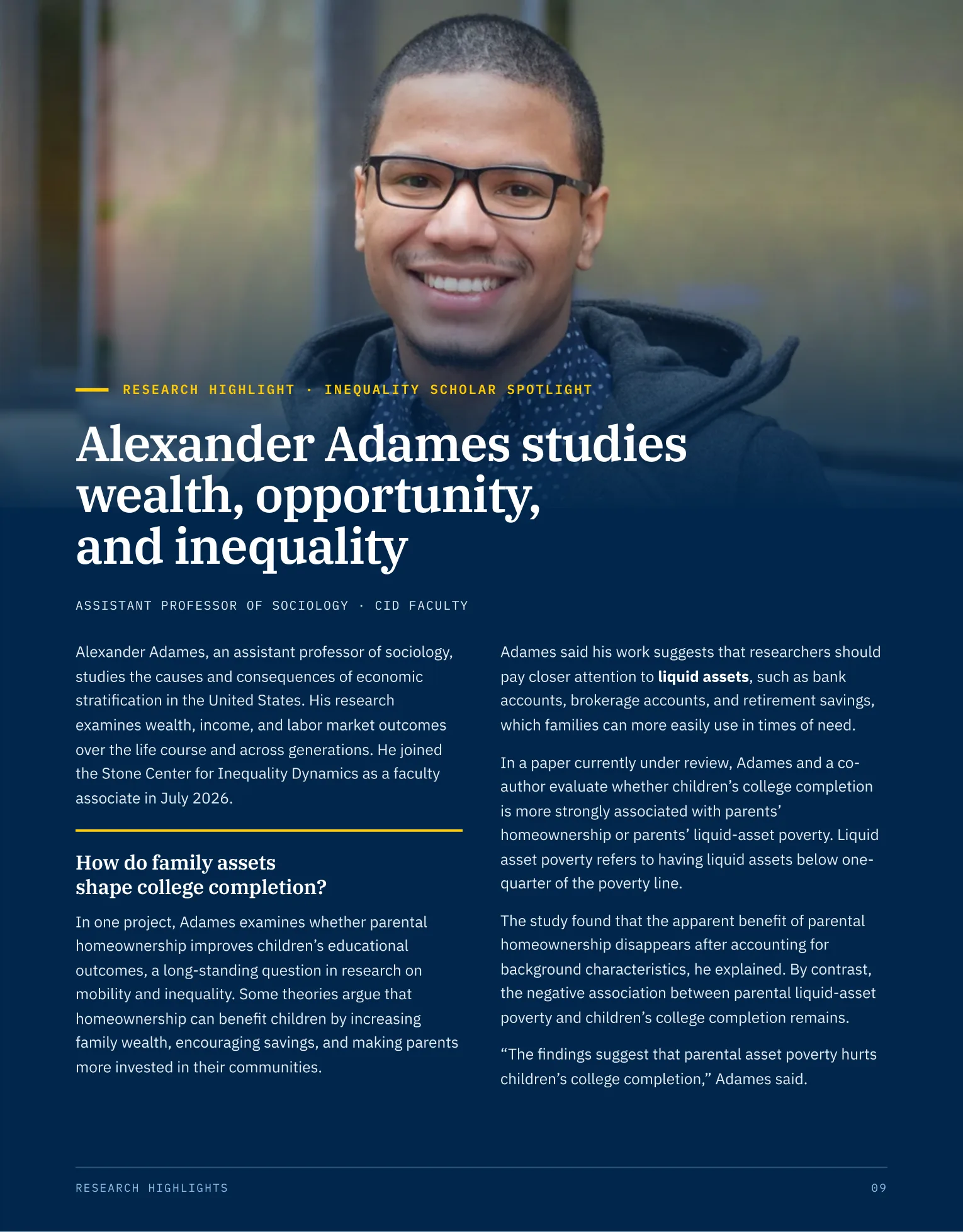
Alexander Adames, an assistant professor of sociology,
studies the causes and consequences of economic
stratification in the United States. His research
examines wealth, income, and labor market outcomes
over the life course and across generations. He joined
the Stone Center for Inequality Dynamics as a faculty
associate in July 2026.
How do family assets
shape college completion?
In one project, Adames examines whether parental
homeownership improves children’s educational
outcomes, a long-standing question in research on
mobility and inequality. Some theories argue that
homeownership can benefit children by increasing
family wealth, encouraging savings, and making parents
more invested in their communities.
Adames said his work suggests that researchers should
pay closer attention to liquid assets, such as bank
accounts, brokerage accounts, and retirement savings,
which families can more easily use in times of need.
In a paper currently under review, Adames and a co-
author evaluate whether children’s college completion
is more strongly associated with parents’
homeownership or parents’ liquid-asset poverty. Liquid
asset poverty refers to having liquid assets below one-
quarter of the poverty line.
The study found that the apparent benefit of parental
homeownership disappears after accounting for
background characteristics, he explained. By contrast,
the negative association between parental liquid-asset
poverty and children’s college completion remains.
“The findings suggest that parental asset poverty hurts
children’s college completion,” Adames said.
RESEARCH HIGHLIGHTS
09
ALEXANDER ADAMES · CONTINUED
RESEARCH HIGHLIGHTS
The project is part of Adames’ broader research
agenda on economic inequality, wealth and mobility.
He said wealth is important because it reflects more
than income.
“Wealth becomes an indicator of a person’s financial
security,” Adames said. “It is the pool of capital
people have to protect themselves.”
Who participates in
the stock market?
Adames is also developing research on racial
differences in stock market participation. He said the
question matters because households increasingly
bear responsibility for retirement security and
financial risk. While homeownership remains a major
source of wealth for many families, liquid assets can
be more readily used during economic hardship.
He said existing research often focuses on financial
literacy or risk aversion, but those explanations raise
further questions.
“Why are some people more informed about financial
markets than others?” Adames said.
How do earnings and
education impact romantic
prospects in online dating?
In a separate line of research, Adames studies
romantic desirability in online dating. He and
collaborators have conducted an experiment using
fictional dating profiles to examine how educational
prestige, for-profit college attendance, and
gendered expectations around earnings shape
dating preferences.
The experiment asked participants how likely they
would be to “swipe right” on profiles with randomized
characteristics. The design allowed researchers to
estimate the causal effect of those characteristics on
romantic interest.
Adames said the project connects to broader
questions about inequality because relationships and
family formation are shaped by education, class, and
social expectations.
The path to sociology
Adames said his interest in sociology began during his
first semester of college, when he took a writing
course on social class in America. The course helped
him make sense of class differences he had observed
growing up in New York City and working as an intern
at the American Museum of Natural History.
“Taking sociology classes started to inform what I had
been seeing,” Adames said. “Talking and writing
about inequality seemed really appealing to me.”
Adames earned his doctorate in sociology from the
University of Pennsylvania, where he was an Institute
of Education Sciences predoctoral fellow. He also
earned a master’s degree in statistics from the
Wharton School. He received his bachelor’s degree in
sociology from the University of Virginia.
Adames said research allows him to study questions
that have long interested him while using data to
examine patterns in social life.
“I liked thinking about inequality and looking at
graphs and making sense of data,” he said.
“Wealth becomes an indicator of a person’s financial security.
It is the pool of capital people have to protect themselves.”
RESEARCH HIGHLIGHTS
10
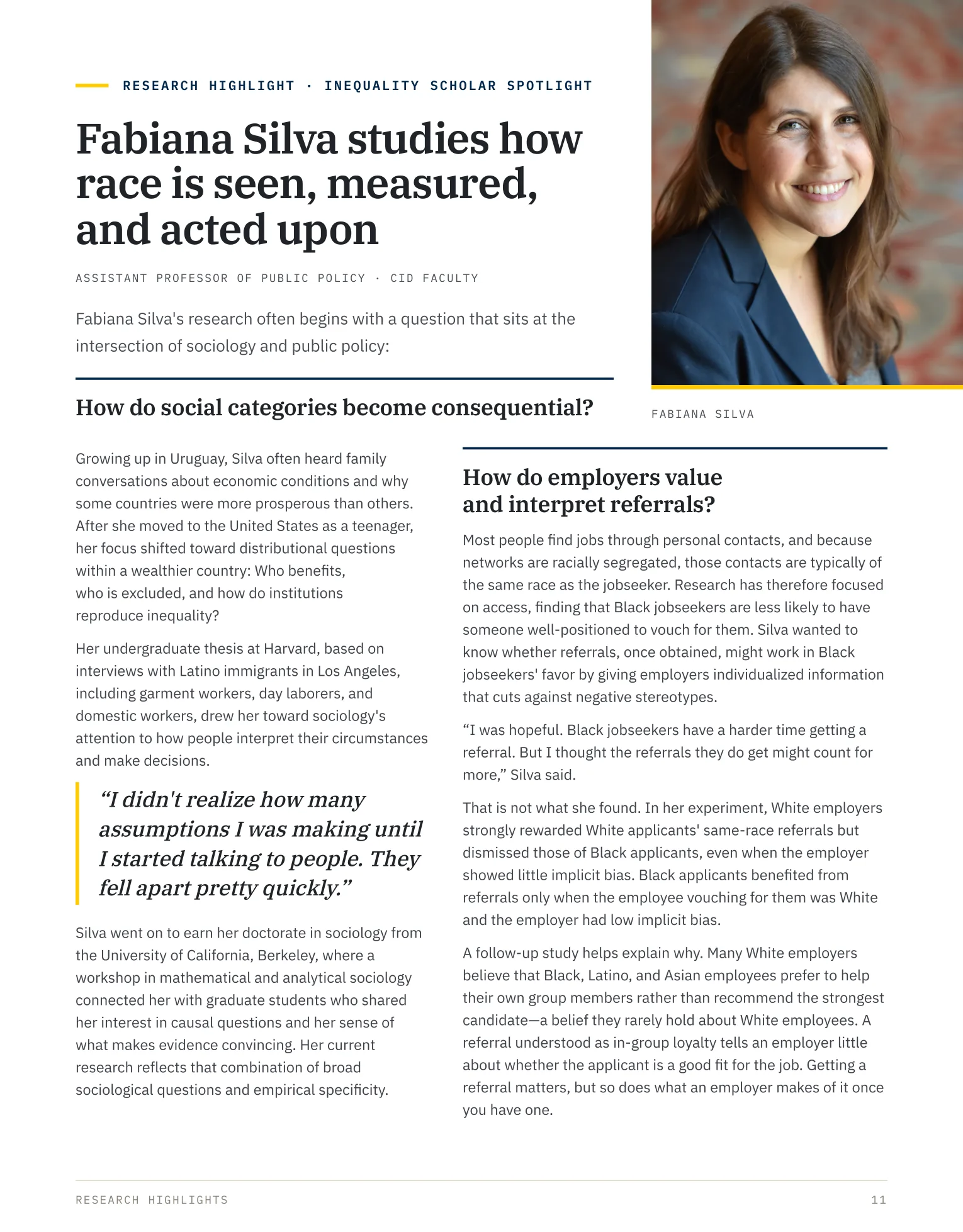
RESEARCH HIGHLIGHT · INEQUALITY SCHOLAR SPOTLIGHT
Fabiana Silva studies how
race is seen, measured,
and acted upon
ASSISTANT PROFESSOR OF PUBLIC POLICY · CID FACULTY
Fabiana Silva's research often begins with a question that sits at the
intersection of sociology and public policy:
How do social categories become consequential?
FABIANA SILVA
Growing up in Uruguay, Silva often heard family
conversations about economic conditions and why
some countries were more prosperous than others.
After she moved to the United States as a teenager,
her focus shifted toward distributional questions
within a wealthier country: Who benefits,
who is excluded, and how do institutions
reproduce inequality?
Her undergraduate thesis at Harvard, based on
interviews with Latino immigrants in Los Angeles,
including garment workers, day laborers, and
domestic workers, drew her toward sociology's
attention to how people interpret their circumstances
and make decisions.
“I didn't realize how many
assumptions I was making until
I started talking to people. They
fell apart pretty quickly.”
Silva went on to earn her doctorate in sociology from
the University of California, Berkeley, where a
workshop in mathematical and analytical sociology
connected her with graduate students who shared
her interest in causal questions and her sense of
what makes evidence convincing. Her current
research reflects that combination of broad
sociological questions and empirical specificity.
How do employers value
and interpret referrals?
Most people find jobs through personal contacts, and because
networks are racially segregated, those contacts are typically of
the same race as the jobseeker. Research has therefore focused
on access, finding that Black jobseekers are less likely to have
someone well-positioned to vouch for them. Silva wanted to
know whether referrals, once obtained, might work in Black
jobseekers' favor by giving employers individualized information
that cuts against negative stereotypes.
“I was hopeful. Black jobseekers have a harder time getting a
referral. But I thought the referrals they do get might count for
more,” Silva said.
That is not what she found. In her experiment, White employers
strongly rewarded White applicants' same-race referrals but
dismissed those of Black applicants, even when the employer
showed little implicit bias. Black applicants benefited from
referrals only when the employee vouching for them was White
and the employer had low implicit bias.
A follow-up study helps explain why. Many White employers
believe that Black, Latino, and Asian employees prefer to help
their own group members rather than recommend the strongest
candidate—a belief they rarely hold about White employees. A
referral understood as in-group loyalty tells an employer little
about whether the applicant is a good fit for the job. Getting a
referral matters, but so does what an employer makes of it once
you have one.
RESEARCH HIGHLIGHTS
11
FABIANA SILVA · CONTINUED
RESEARCH HIGHLIGHTS
How do Americans racially
classify one another?
Another strand of Silva's work examines “observed
race,” or how people are racially classified by others
rather than how they identify themselves. The
distinction matters because discrimination occurs
through perception, yet nearly all the data used to
measure inequality and enforce civil rights law relies on
self-identification.
Federal statistics have long treated “Hispanic” as an
ethnic group that can be of any race, so that a person
could be ethnically Hispanic and also racially White, or
ethnically Hispanic and racially Black. Silva finds many
Americans reject this view: almost half of observers did
not classify someone as Hispanic—despite speaking
Spanish and having a Spanish name—if that person
looked distinctively White or Black.
The reverse happened as well, though less often.
Appearance was the strongest cue in whether observers
classified someone as White or Black. But name and
language cues associated with Hispanic origins lowered
the likelihood of being classified as White or Black, even
for people whose appearances were perceived as
distinctly White or Black.
Silva's broader argument is that the Hispanic category,
often described as elusive, has become meaningful and
widely understood: Americans agree about classifying a
diverse range of people as Hispanic. In becoming
established, it appears to have reshaped
understandings of Whiteness and Blackness.
Silva is now bringing together her work on classification
with her work on discrimination, testing directly whether
markers like a Spanish surname change not only how an
applicant is racially seen but also how they are treated.
The trouble with civil rights appeals
While Silva's first two lines of work examine how
inequality gets produced, the third examines social
movements' efforts to build public support for
undoing it.
Movements have to convince people that a problem is
unjust and worth acting on, and in the United States
many reach for the language and imagery of the Civil
Rights Movement to make that case. Silva and her
collaborators, Irene Bloemraad and Kim Voss, found
good reason for the strategy's widespread appeal:
Americans across the political spectrum think highly of
civil rights and broadly agree about what it means.
And yet the strategy backfires. Describing contemporary
problems as civil rights violations consistently reduced
support for government intervention—across different
issues, different groups of beneficiaries, and different
audiences. Liberals and conservatives, Black, White, and
Latino respondents all responded negatively.
The problem, Silva suspects, is that the strategy invites
a comparison. Say “civil rights” and people think of the
idealized Civil Rights Movement of the 1960s—and
measured against that, today's problems seem less
pressing and today's movements less impressive.
Silva is often surprised by her findings, which she says is
part of the point. Experiments, she said, are useful
because they can test widely held assumptions and
reveal when expected mechanisms do not operate as
predicted. Her location in a public policy school also
shapes how she thinks about the implications of her
research: public policy students and colleagues push
her to consider not only why inequality persists, but also
what might be done about it.
“So far I've mostly been documenting what doesn't work.
Hopefully I'll next figure out what does.”
RESEARCH HIGHLIGHTS
12
RESEARCH HIGHLIGHTS
Grant Updates and Ongoing Research
RUSSELL SAGE FOUNDATION GRANT
Property-tax burdens by homeowner age and race
Joe LaBriola · Robert Manduca · Pablo Mitnik
A new $200,000 Russell Sage Foundation grant supports three CID faculty members—Joe LaBriola,
Robert Manduca, and Pablo Mitnik—in studying unequal property-tax burdens. The researchers will use
nationwide assessed and estimated market values for residential properties in 2019, linked to
homeowner information, to examine differences by age and race and the role of assessment caps—limits
on increases in a property’s taxable assessed value.
SOCIAL MOBILITY LAB RESEARCH GRANT
Social Mobility Lab award supports
Adames’s research on lifetime mobility
Alexander Adames
CID faculty member Alexander Adames was named a 2026-27 Social Mobility Lab research grantee at
The City College of New York’s Colin Powell School for Civic and Global Leadership. His project will
examine racial and cohort differences in mobility across the life course by developing a lifetime measure
and estimating when people first experience upward or downward mobility.
ONGOING RESEARCH
The Wealth and Mobility Study
Pablo Mitnik · Project Director
The Wealth and Mobility Study (WAM), led by project director Pablo Mitnik, is developing estimates of
wealth, income, inequality, segregation, and mobility using population-level tax and housing records. Over
the past year, WAM has focused on improving family-level wealth measures, including incorporating
housing information and refining methods for estimating asset holdings from tax records. This work lays
the foundation for population-level estimates of the wealth held by the top 1%, 5%, and 10%, nationally
and across subnational geographies, which will enable researchers to examine both wealth concentration
within areas and differences across them.
RESEARCH HIGHLIGHTS
13
TEACHING AND TRAINING
Teaching and Training
Mentorship and training are central to the Stone Center's mission.
66
Graduate students and postdocs
In CID’s active community, as of
September 2026
16
CID-affiliated students
Who were mentored by or
collaborated with CID faculty last year
33
Center events
Held during the past year
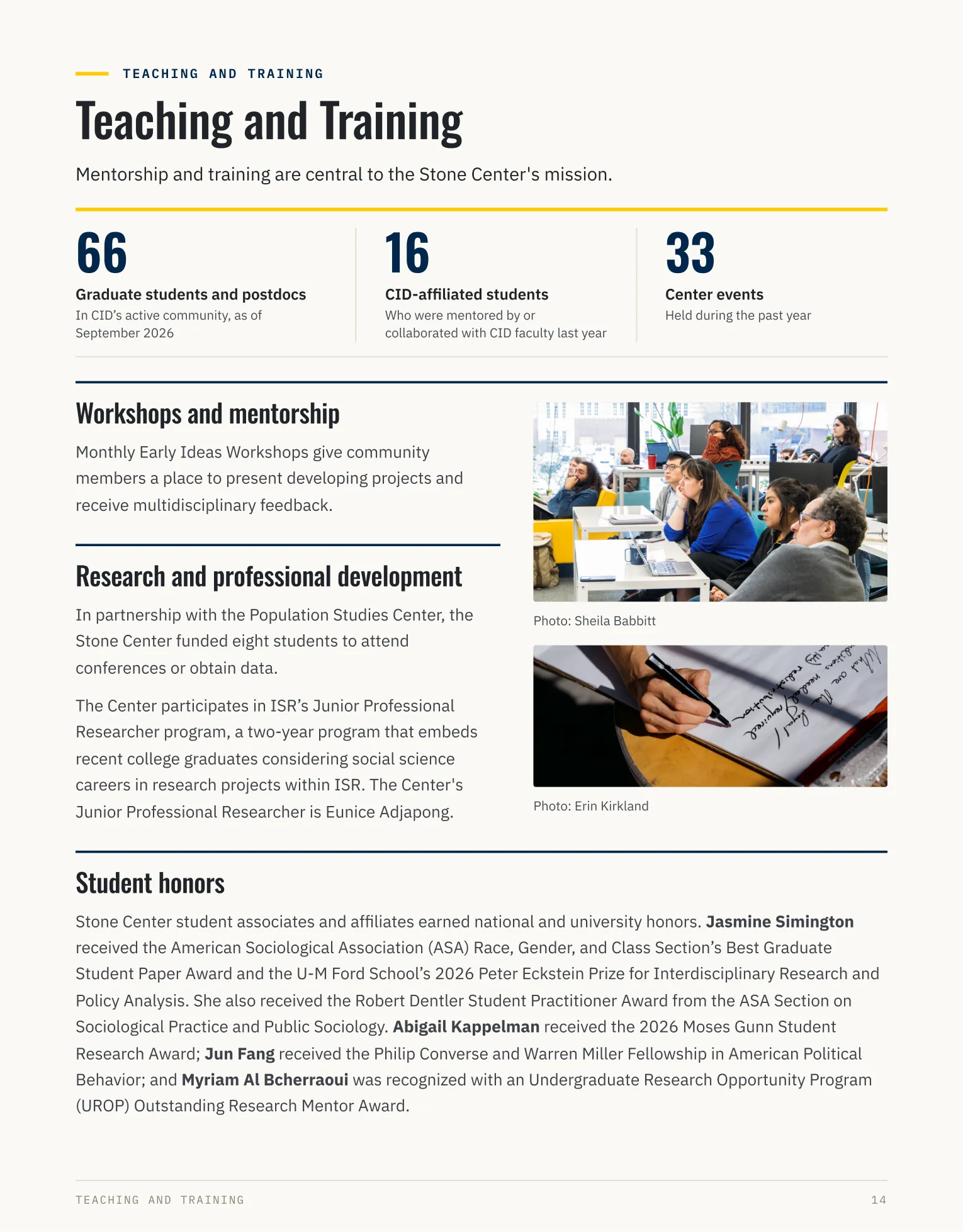
Workshops and mentorship
Monthly Early Ideas Workshops give community
members a place to present developing projects and
receive multidisciplinary feedback.
Research and professional development
In partnership with the Population Studies Center, the
Stone Center funded eight students to attend
conferences or obtain data.
The Center participates in ISR’s Junior Professional
Researcher program, a two-year program that embeds
recent college graduates considering social science
careers in research projects within ISR. The Center's
Junior Professional Researcher is Eunice Adjapong.
Photo: Sheila Babbitt
Photo: Erin Kirkland
Student honors
Stone Center student associates and affiliates earned national and university honors. Jasmine Simington
received the American Sociological Association (ASA) Race, Gender, and Class Section’s Best Graduate
Student Paper Award and the U-M Ford School’s 2026 Peter Eckstein Prize for Interdisciplinary Research and
Policy Analysis. She also received the Robert Dentler Student Practitioner Award from the ASA Section on
Sociological Practice and Public Sociology. Abigail Kappelman received the 2026 Moses Gunn Student
Research Award; Jun Fang received the Philip Converse and Warren Miller Fellowship in American Political
Behavior; and Myriam Al Bcherraoui was recognized with an Undergraduate Research Opportunity Program
(UROP) Outstanding Research Mentor Award.
TEACHING AND TRAINING
14
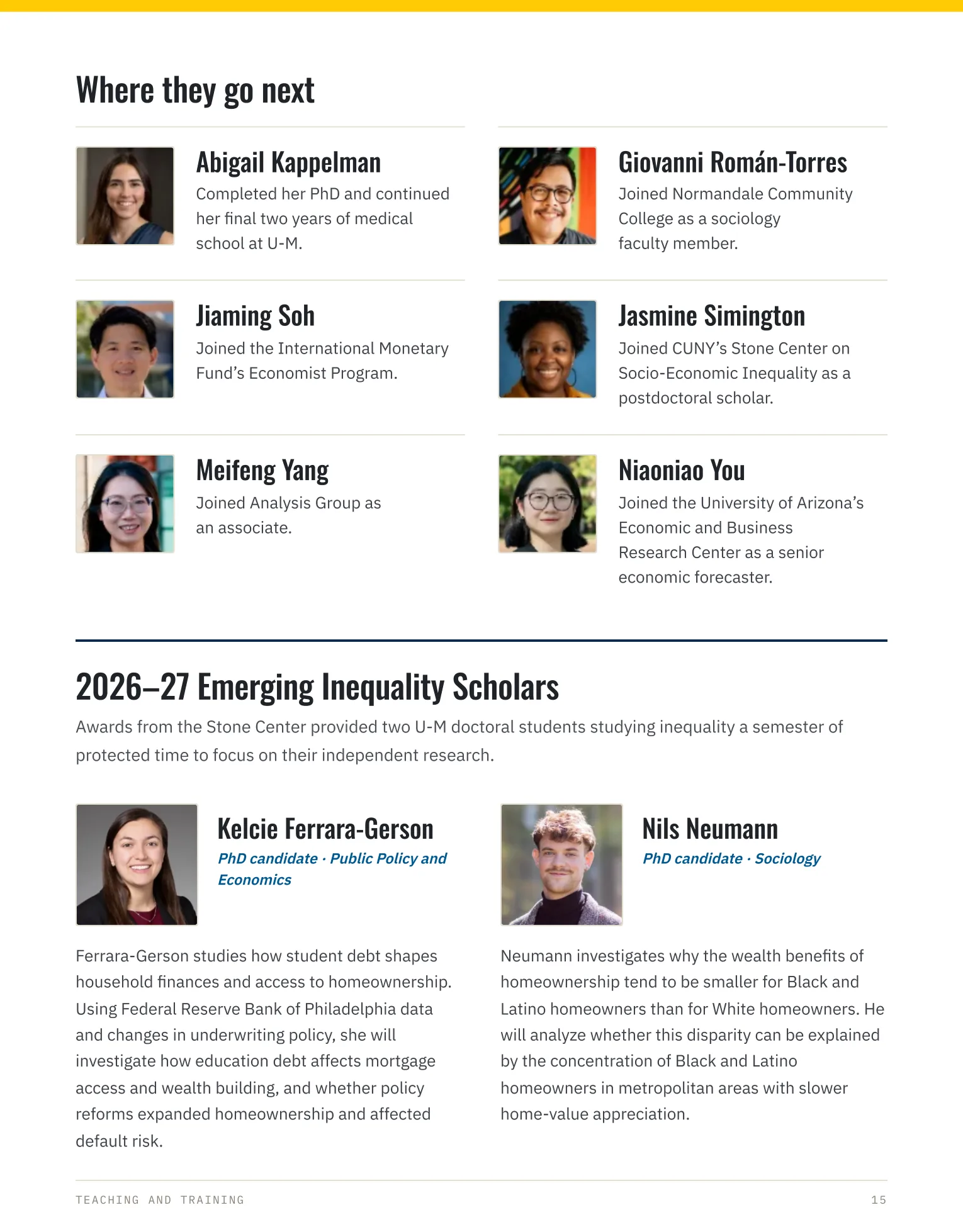
Where they go next
Abigail Kappelman
Completed her PhD and continued
her final two years of medical
school at U-M.
Giovanni Román-Torres
Joined Normandale Community
College as a sociology
faculty member.
Jiaming Soh
Joined the International Monetary
Fund’s Economist Program.
Jasmine Simington
Joined CUNY’s Stone Center on
Socio-Economic Inequality as a
postdoctoral scholar.
Meifeng Yang
Joined Analysis Group as
an associate.
Niaoniao You
Joined the University of Arizona’s
Economic and Business
Research Center as a senior
economic forecaster.
2026–27 Emerging Inequality Scholars
Awards from the Stone Center provided two U-M doctoral students studying inequality a semester of
protected time to focus on their independent research.
Kelcie Ferrara-Gerson
PhD candidate · Public Policy and
Economics
Ferrara-Gerson studies how student debt shapes
household finances and access to homeownership.
Using Federal Reserve Bank of Philadelphia data
and changes in underwriting policy, she will
investigate how education debt affects mortgage
access and wealth building, and whether policy
reforms expanded homeownership and affected
default risk.
Nils Neumann
PhD candidate · Sociology
Neumann investigates why the wealth benefits of
homeownership tend to be smaller for Black and
Latino homeowners than for White homeowners. He
will analyze whether this disparity can be explained
by the concentration of Black and Latino
homeowners in metropolitan areas with slower
home-value appreciation.
TEACHING AND TRAINING
15
TEACHING AND TRAINING
Postdoctoral research
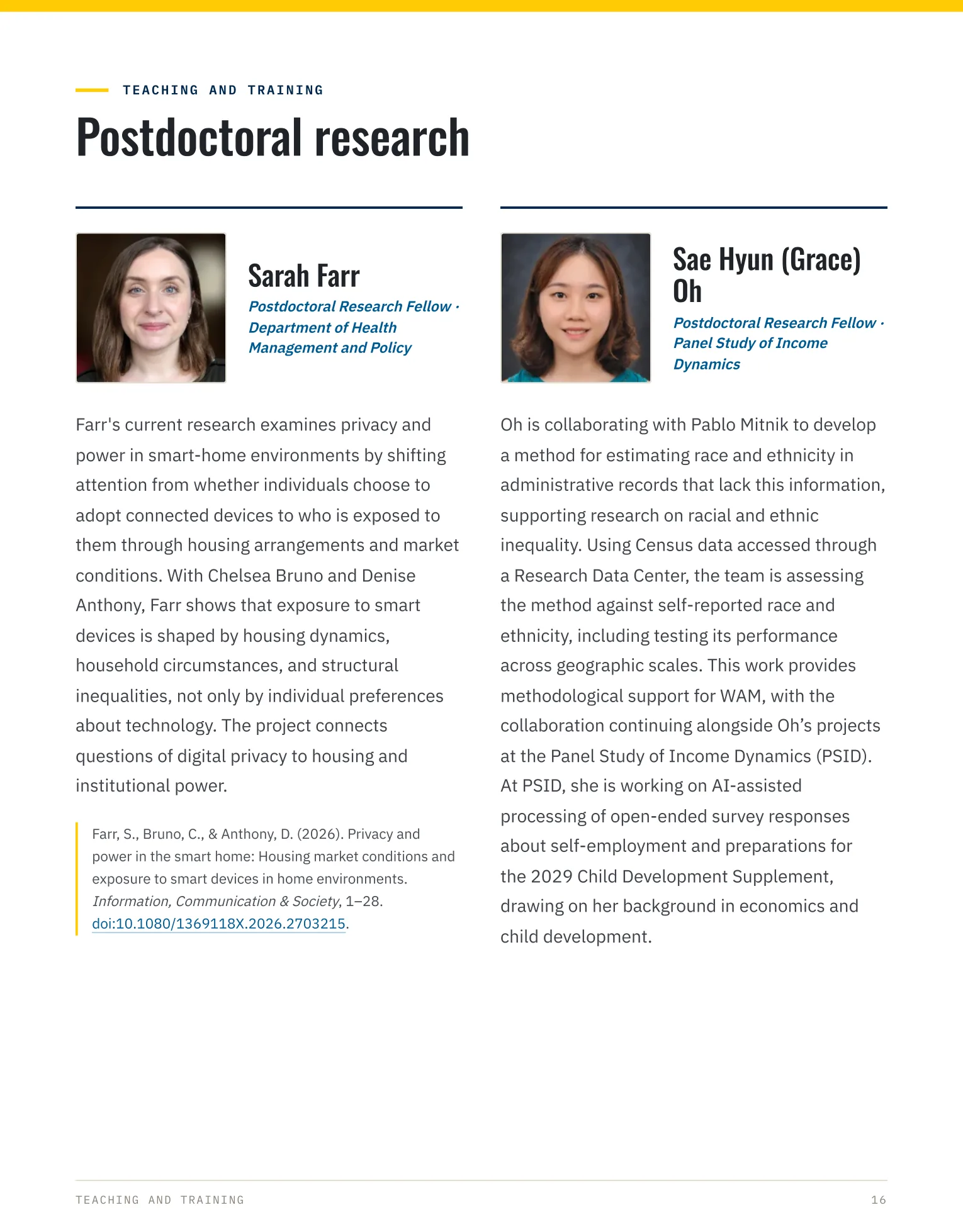
Sarah Farr
Postdoctoral Research Fellow ·
Department of Health
Management and Policy
Farr's current research examines privacy and
power in smart-home environments by shifting
attention from whether individuals choose to
adopt connected devices to who is exposed to
them through housing arrangements and market
conditions. With Chelsea Bruno and Denise
Anthony, Farr shows that exposure to smart
devices is shaped by housing dynamics,
household circumstances, and structural
inequalities, not only by individual preferences
about technology. The project connects
questions of digital privacy to housing and
institutional power.
Farr, S., Bruno, C., & Anthony, D. (2026). Privacy and
power in the smart home: Housing market conditions and
exposure to smart devices in home environments.
Information, Communication & Society, 1–28.
doi:10.1080/1369118X.2026.2703215.
Sae Hyun (Grace)
Oh
Postdoctoral Research Fellow ·
Panel Study of Income
Dynamics
Oh is collaborating with Pablo Mitnik to develop
a method for estimating race and ethnicity in
administrative records that lack this information,
supporting research on racial and ethnic
inequality. Using Census data accessed through
a Research Data Center, the team is assessing
the method against self-reported race and
ethnicity, including testing its performance
across geographic scales. This work provides
methodological support for WAM, with the
collaboration continuing alongside Oh’s projects
at the Panel Study of Income Dynamics (PSID).
At PSID, she is working on AI-assisted
processing of open-ended survey responses
about self-employment and preparations for
the 2029 Child Development Supplement,
drawing on her background in economics and
child development.
TEACHING AND TRAINING
16
LECTURES AND PROGRAMMING
The 2025–26 Speaker Series
The 2025–26 Speaker Series included research on the institutions through
which economic advantage is accumulated and sustained. These speakers
brought work from fields including economic sociology, political economy,
and economics into the Stone Center’s ongoing discussion of inequality.
16
Guest speakers during
the past year
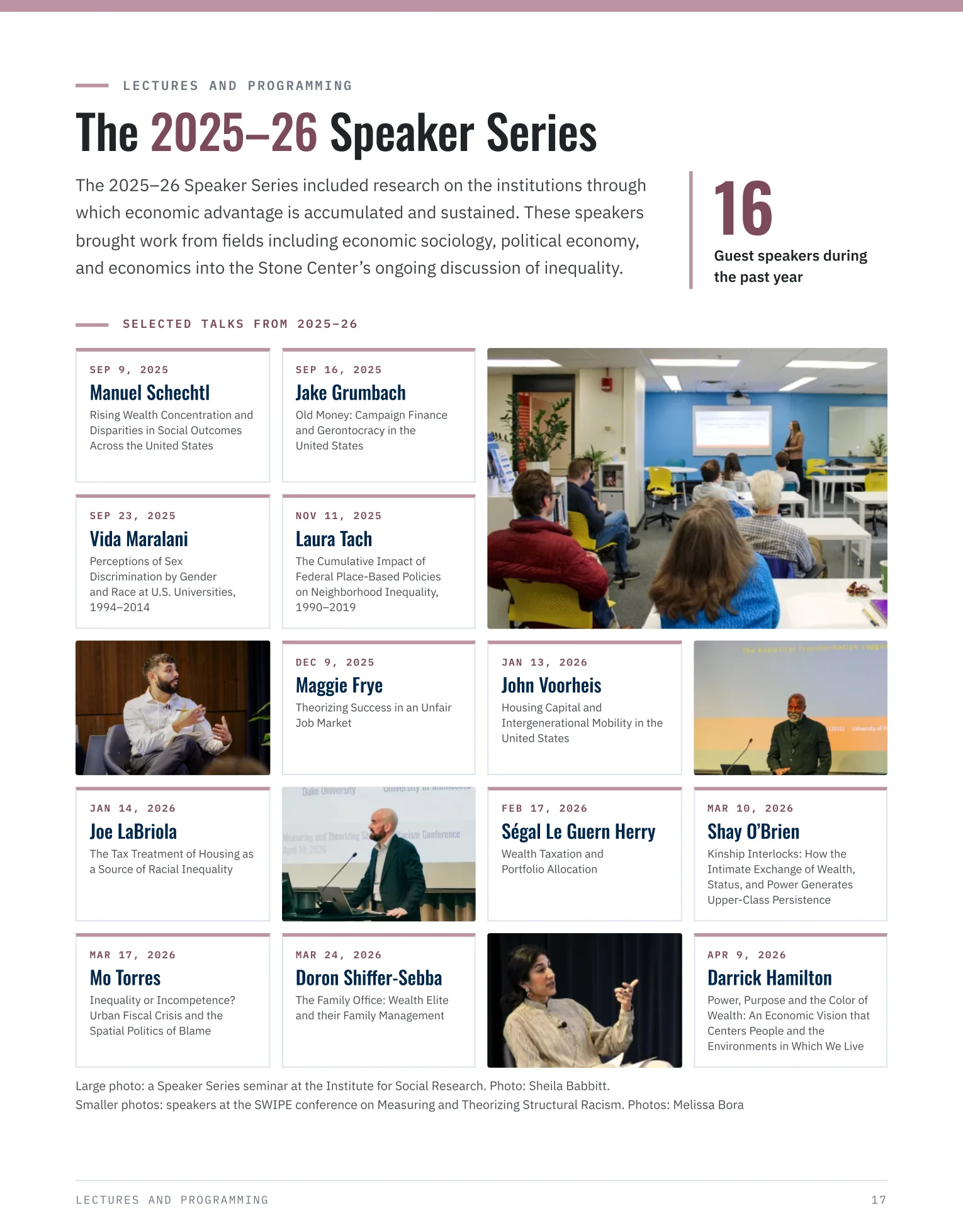
SELECTED TALKS FROM 2025–26
SEP 9, 2025
Manuel Schechtl
Rising Wealth Concentration and
Disparities in Social Outcomes
Across the United States
SEP 16, 2025
Jake Grumbach
Old Money: Campaign Finance
and Gerontocracy in the
United States
SEP 23, 2025
Vida Maralani
Perceptions of Sex
Discrimination by Gender
and Race at U.S. Universities,
1994–2014
NOV 11, 2025
Laura Tach
The Cumulative Impact of
Federal Place-Based Policies
on Neighborhood Inequality,
1990–2019
DEC 9, 2025
Maggie Frye
Theorizing Success in an Unfair
Job Market
JAN 13, 2026
John Voorheis
Housing Capital and
Intergenerational Mobility in the
United States
JAN 14, 2026
Joe LaBriola
The Tax Treatment of Housing as
a Source of Racial Inequality
FEB 17, 2026
Ségal Le Guern Herry
Wealth Taxation and
Portfolio Allocation
MAR 10, 2026
Shay O’Brien
Kinship Interlocks: How the
Intimate Exchange of Wealth,
Status, and Power Generates
Upper-Class Persistence
MAR 17, 2026
Mo Torres
Inequality or Incompetence?
Urban Fiscal Crisis and the
Spatial Politics of Blame
MAR 24, 2026
Doron Shiffer-Sebba
The Family Office: Wealth Elite
and their Family Management
APR 9, 2026
Darrick Hamilton
Power, Purpose and the Color of
Wealth: An Economic Vision that
Centers People and the
Environments in Which We Live
Large photo: a Speaker Series seminar at the Institute for Social Research. Photo: Sheila Babbitt.
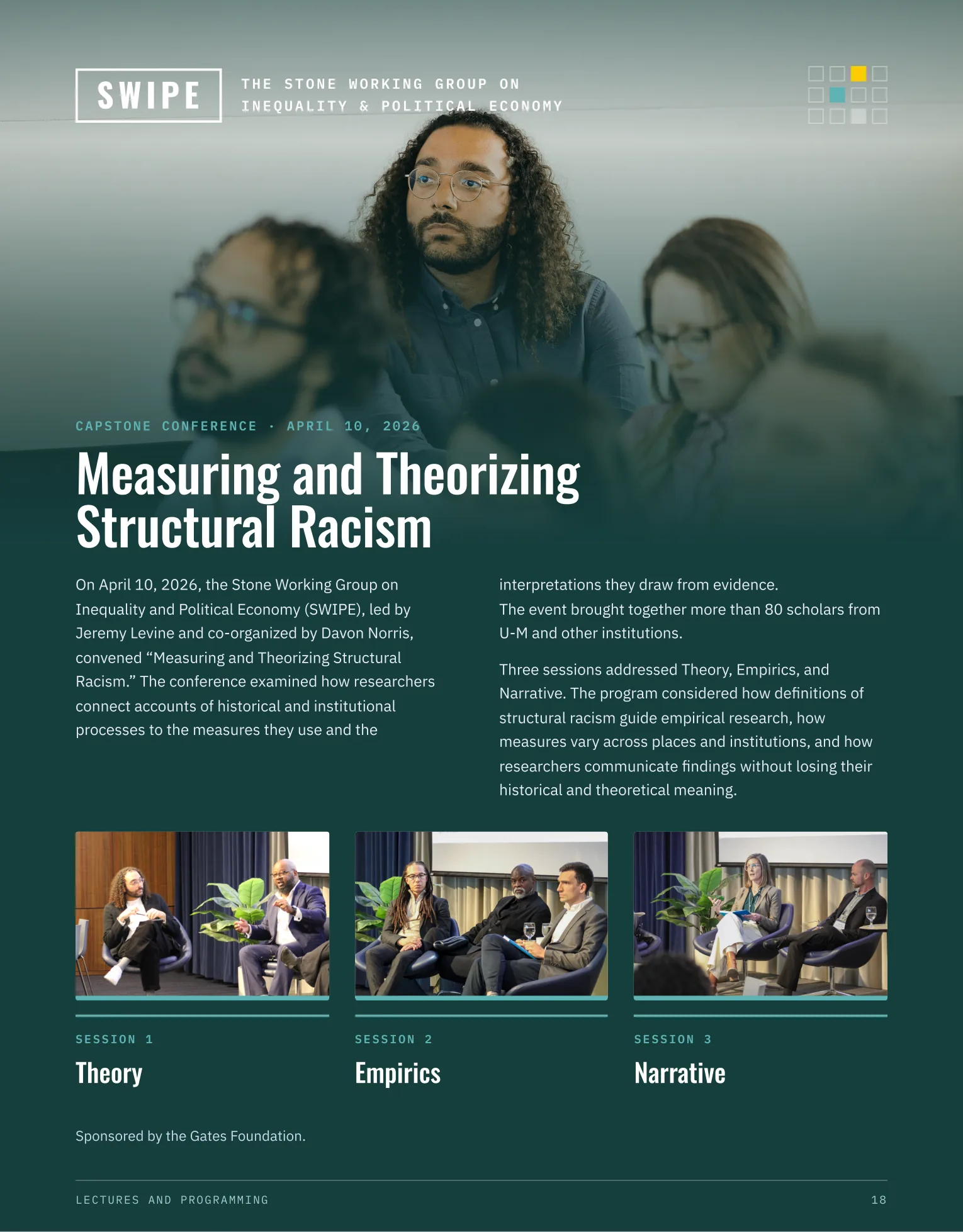
Smaller photos: speakers at the SWIPE conference on Measuring and Theorizing Structural Racism. Photos: Melissa Bora
LECTURES AND PROGRAMMING
17
SWIPE
T H E S T O N E W O R K I N G G R O U P O N
I N E Q U A L I T Y & P O L I T I C A L E C O N O M Y
CAPSTONE CONFERENCE · APRIL 10, 2026
Measuring and Theorizing
Structural Racism
On April 10, 2026, the Stone Working Group on
Inequality and Political Economy (SWIPE), led by
Jeremy Levine and co-organized by Davon Norris,
convened “Measuring and Theorizing Structural
Racism.” The conference examined how researchers
connect accounts of historical and institutional
processes to the measures they use and the
interpretations they draw from evidence.
The event brought together more than 80 scholars from
U-M and other institutions.
Three sessions addressed Theory, Empirics, and
Narrative. The program considered how definitions of
structural racism guide empirical research, how
measures vary across places and institutions, and how
researchers communicate findings without losing their
historical and theoretical meaning.
SESSION 1
Theory
SESSION 2
Empirics
SESSION 3
Narrative
Sponsored by the Gates Foundation.
LECTURES AND PROGRAMMING
18
AWARDS AND MEDIA HIGHLIGHTS
Awards
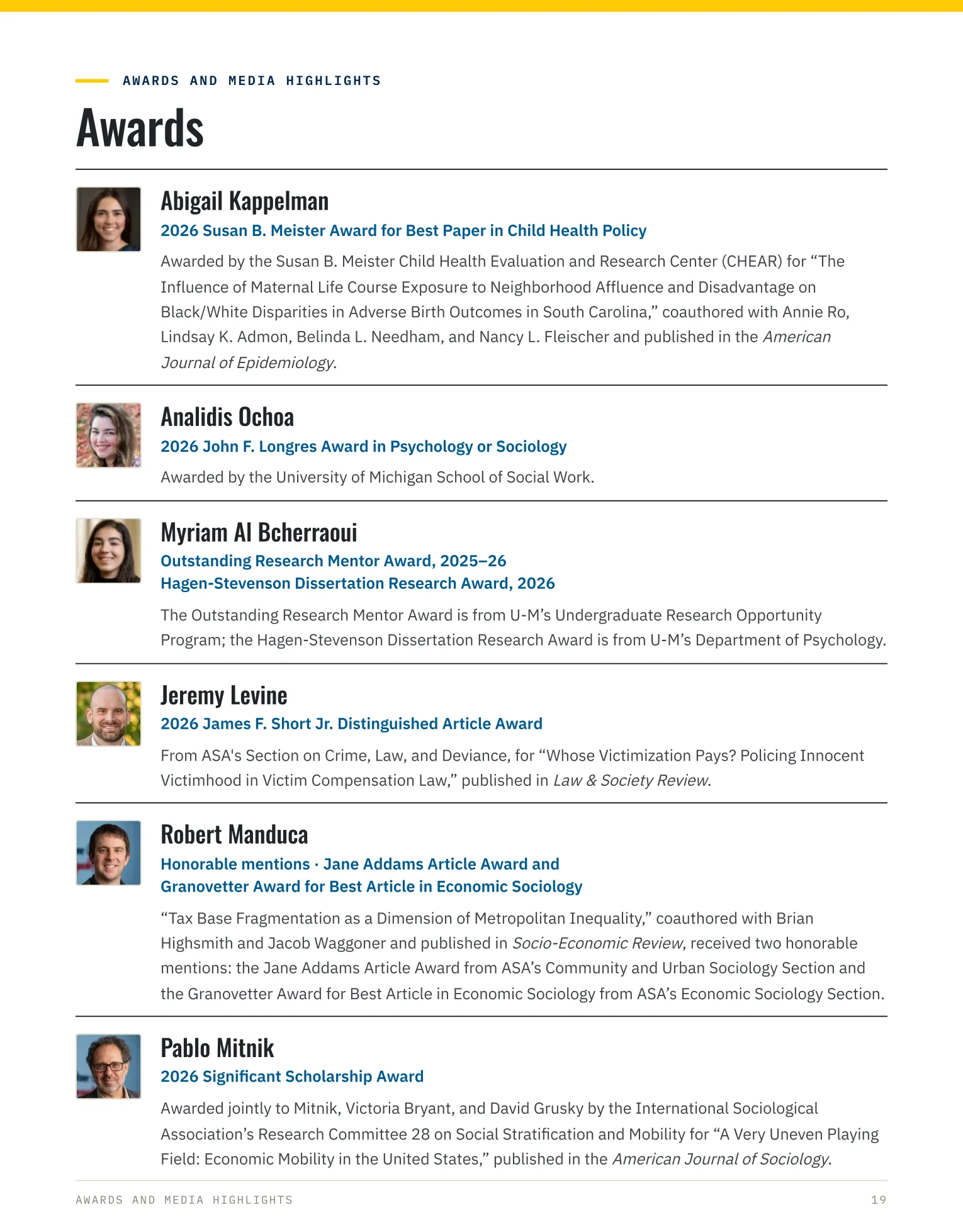
Abigail Kappelman
2026 Susan B. Meister Award for Best Paper in Child Health Policy
Awarded by the Susan B. Meister Child Health Evaluation and Research Center (CHEAR) for “The
Influence of Maternal Life Course Exposure to Neighborhood Affluence and Disadvantage on
Black/White Disparities in Adverse Birth Outcomes in South Carolina,” coauthored with Annie Ro,
Lindsay K. Admon, Belinda L. Needham, and Nancy L. Fleischer and published in the American
Journal of Epidemiology.
Analidis Ochoa
2026 John F. Longres Award in Psychology or Sociology
Awarded by the University of Michigan School of Social Work.
Myriam Al Bcherraoui
Outstanding Research Mentor Award, 2025–26
Hagen-Stevenson Dissertation Research Award, 2026
The Outstanding Research Mentor Award is from U-M’s Undergraduate Research Opportunity
Program; the Hagen-Stevenson Dissertation Research Award is from U-M’s Department of Psychology.
Jeremy Levine
2026 James F. Short Jr. Distinguished Article Award
From ASA's Section on Crime, Law, and Deviance, for “Whose Victimization Pays? Policing Innocent
Victimhood in Victim Compensation Law,” published in Law & Society Review.
Robert Manduca
Honorable mentions · Jane Addams Article Award and
Granovetter Award for Best Article in Economic Sociology
“Tax Base Fragmentation as a Dimension of Metropolitan Inequality,” coauthored with Brian
Highsmith and Jacob Waggoner and published in Socio-Economic Review, received two honorable
mentions: the Jane Addams Article Award from ASA’s Community and Urban Sociology Section and
the Granovetter Award for Best Article in Economic Sociology from ASA’s Economic Sociology Section.
Pablo Mitnik
2026 Significant Scholarship Award
Awarded jointly to Mitnik, Victoria Bryant, and David Grusky by the International Sociological
Association’s Research Committee 28 on Social Stratification and Mobility for “A Very Uneven Playing
Field: Economic Mobility in the United States,” published in the American Journal of Sociology.
AWARDS AND MEDIA HIGHLIGHTS
19
AWARDS AND MEDIA HIGHLIGHTS
Media Highlights
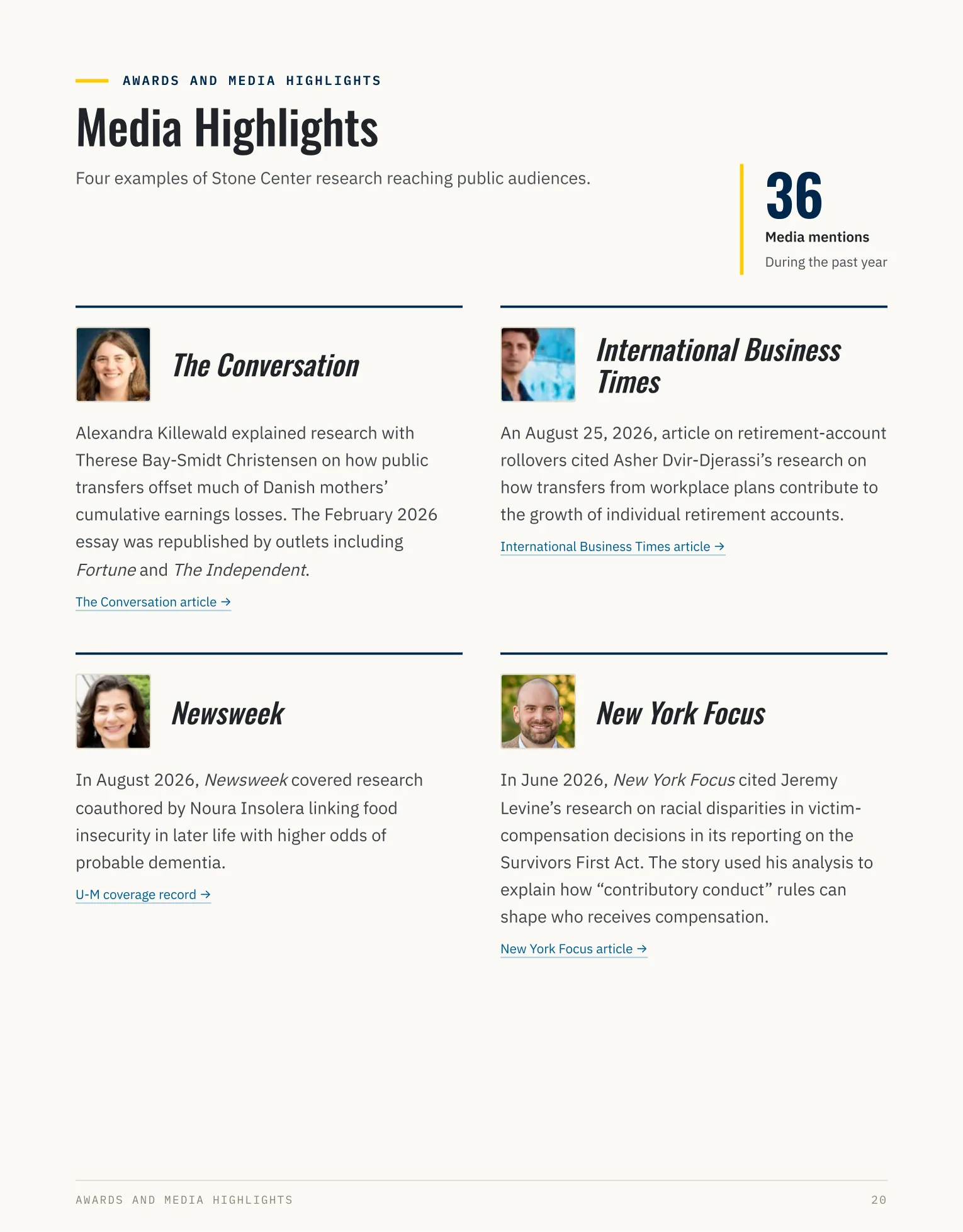
Four examples of Stone Center research reaching public audiences.
36
Media mentions
During the past year
The Conversation
Alexandra Killewald explained research with
Therese Bay-Smidt Christensen on how public
transfers offset much of Danish mothers’
cumulative earnings losses. The February 2026
essay was republished by outlets including
Fortune and The Independent.
The Conversation article →
International Business
Times
An August 25, 2026, article on retirement-account
rollovers cited Asher Dvir-Djerassi’s research on
how transfers from workplace plans contribute to
the growth of individual retirement accounts.
International Business Times article →
Newsweek
In August 2026, Newsweek covered research
coauthored by Noura Insolera linking food
insecurity in later life with higher odds of
probable dementia.
U-M coverage record →
New York Focus
In June 2026, New York Focus cited Jeremy
Levine’s research on racial disparities in victim-
compensation decisions in its reporting on the
Survivors First Act. The story used his analysis to
explain how “contributory conduct” rules can
shape who receives compensation.
New York Focus article →
AWARDS AND MEDIA HIGHLIGHTS
20
THE YEAR AHEAD
The 2026–27 Speaker Series
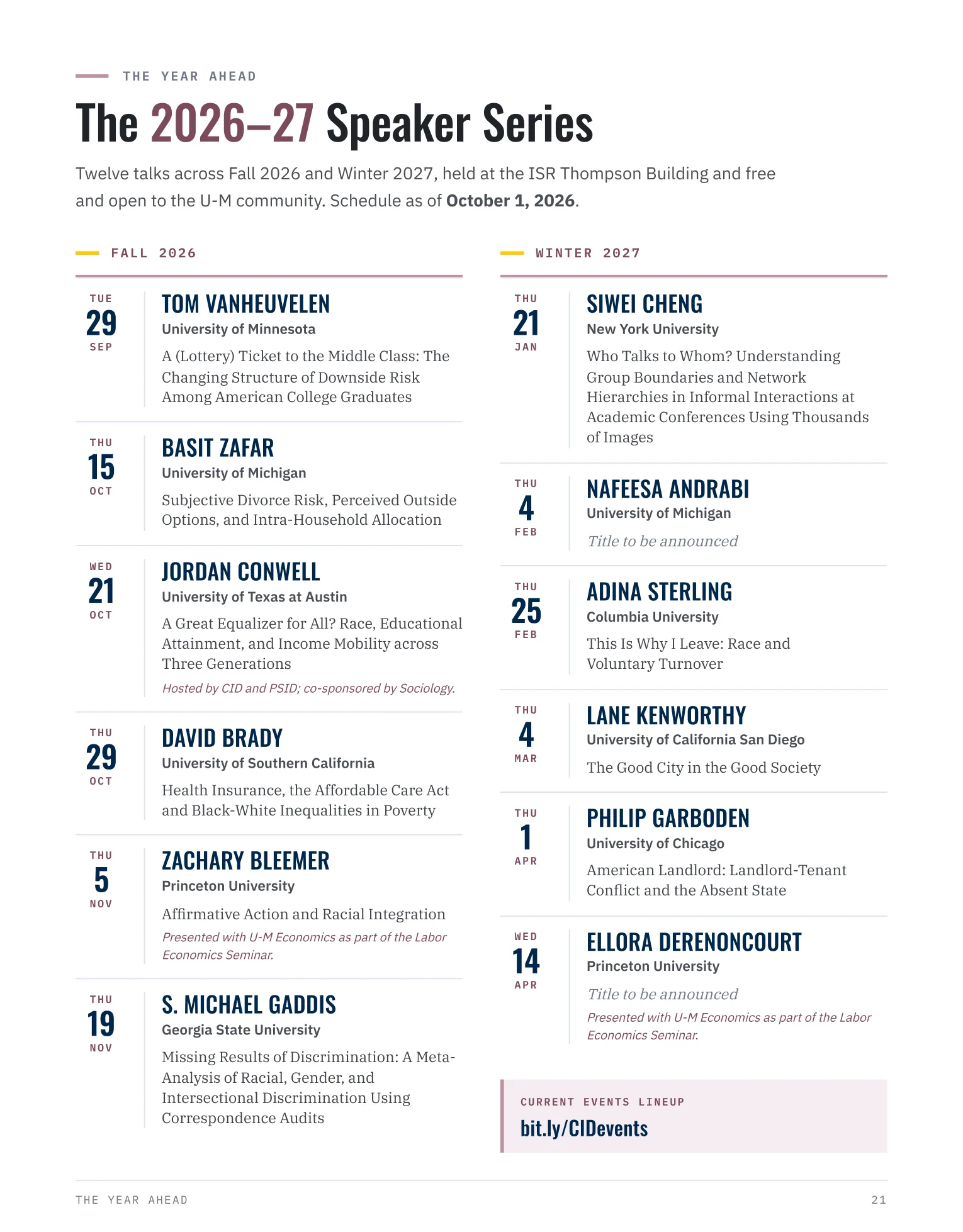
Twelve talks across Fall 2026 and Winter 2027, held at the ISR Thompson Building and free
and open to the U-M community. Schedule as of October 1, 2026.
FALL 2026
TUE
29
SEP
TOM VANHEUVELEN
University of Minnesota
A (Lottery) Ticket to the Middle Class: The
Changing Structure of Downside Risk
Among American College Graduates
THU
15
OCT
BASIT ZAFAR
University of Michigan
Subjective Divorce Risk, Perceived Outside
Options, and Intra-Household Allocation
WED
21
OCT
JORDAN CONWELL
University of Texas at Austin
A Great Equalizer for All? Race, Educational
Attainment, and Income Mobility across
Three Generations
Hosted by CID and PSID; co-sponsored by Sociology.
THU
29
OCT
DAVID BRADY
University of Southern California
Health Insurance, the Affordable Care Act
and Black-White Inequalities in Poverty
THU
5
NOV
ZACHARY BLEEMER
Princeton University
Affirmative Action and Racial Integration
Presented with U-M Economics as part of the Labor
Economics Seminar.
THU
19
NOV
S. MICHAEL GADDIS
Georgia State University
Missing Results of Discrimination: A Meta-
Analysis of Racial, Gender, and
Intersectional Discrimination Using
Correspondence Audits
WINTER 2027
THU
21
JAN
SIWEI CHENG
New York University
Who Talks to Whom? Understanding
Group Boundaries and Network
Hierarchies in Informal Interactions at
Academic Conferences Using Thousands
of Images
THU
4
FEB
NAFEESA ANDRABI
University of Michigan
Title to be announced
THU
25
FEB
ADINA STERLING
Columbia University
This Is Why I Leave: Race and
Voluntary Turnover
THU
4
MAR
LANE KENWORTHY
University of California San Diego
The Good City in the Good Society
THU
1
APR
PHILIP GARBODEN
University of Chicago
American Landlord: Landlord-Tenant
Conflict and the Absent State
WED
14
APR
ELLORA DERENONCOURT
Princeton University
Title to be announced
Presented with U-M Economics as part of the Labor
Economics Seminar.
CURRENT EVENTS LINEUP
bit.ly/CIDevents
THE YEAR AHEAD
21
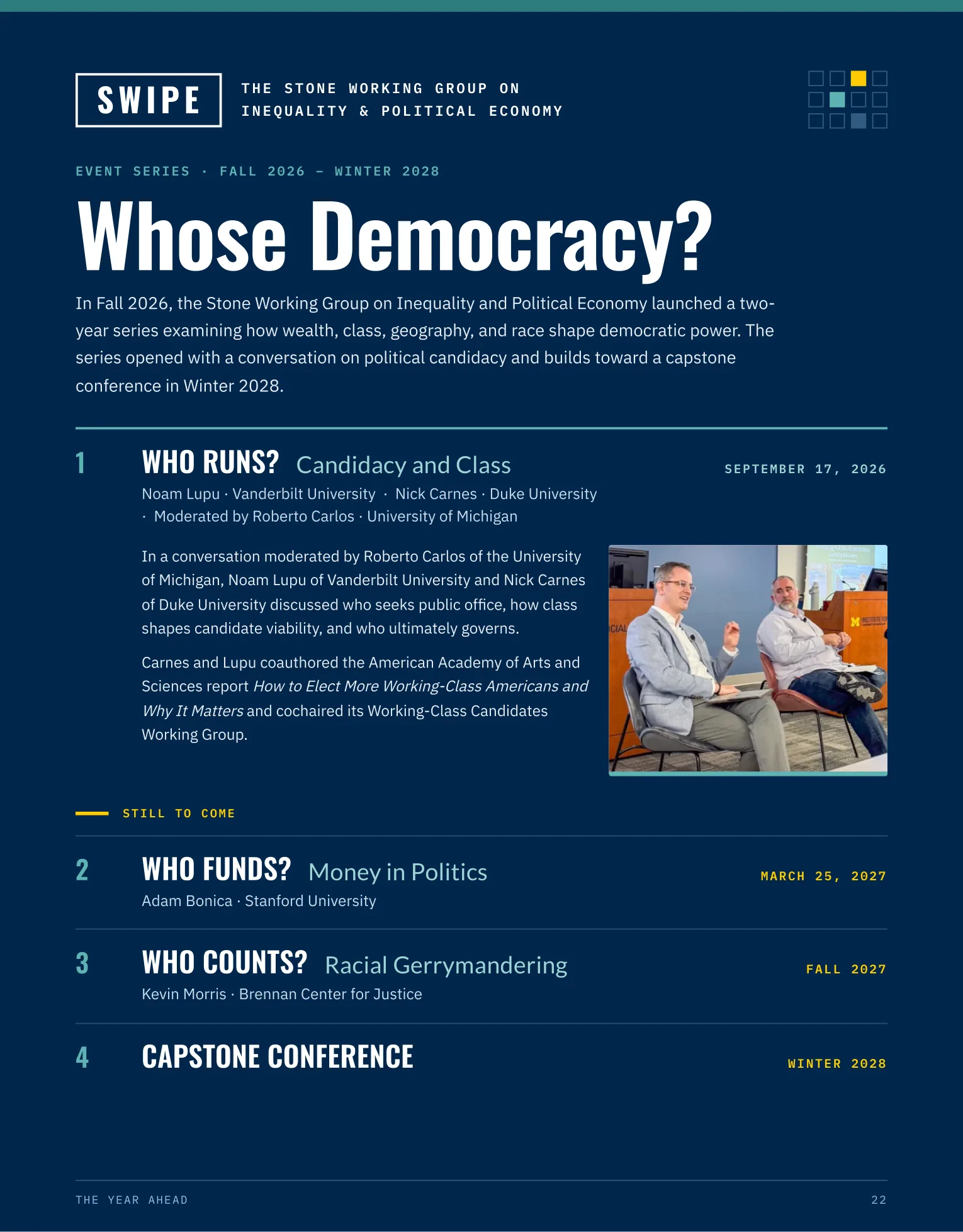
SWIPE
T H E S T O N E W O R K I N G G R O U P O N
I N E Q U A L I T Y & P O L I T I C A L E C O N O M Y
EVENT SERIES · FALL 2026 – WINTER 2028
Whose Democracy?
In Fall 2026, the Stone Working Group on Inequality and Political Economy launched a two-
year series examining how wealth, class, geography, and race shape democratic power. The
series opened with a conversation on political candidacy and builds toward a capstone
conference in Winter 2028.
1
WHO RUNS? Candidacy and Class
Noam Lupu · Vanderbilt University · Nick Carnes · Duke University
· Moderated by Roberto Carlos · University of Michigan
SEPTEMBER 17, 2026
In a conversation moderated by Roberto Carlos of the University
of Michigan, Noam Lupu of Vanderbilt University and Nick Carnes
of Duke University discussed who seeks public office, how class
shapes candidate viability, and who ultimately governs.
Carnes and Lupu coauthored the American Academy of Arts and
Sciences report How to Elect More Working-Class Americans and
Why It Matters and cochaired its Working-Class Candidates
Working Group.
STILL TO COME
2
WHO FUNDS? Money in Politics
Adam Bonica · Stanford University
MARCH 25, 2027
3
WHO COUNTS? Racial Gerrymandering
Kevin Morris · Brennan Center for Justice
FALL 2027
4
CAPSTONE CONFERENCE
WINTER 2028
THE YEAR AHEAD
22
Acknowledgments
The Stone Center for Inequality Dynamics is grateful to the James M. and
Cathleen D. Stone Foundation for its sustained support of the Center’s
research and training.
We also thank our partners across the Institute for Social Research and the
University of Michigan; the Center’s visitors; and the faculty, postdoctoral
fellows, students, and staff who make up the Stone Center community.
CONTACT
Stone Center for Inequality Dynamics
Institute for Social Research
University of Michigan
Ann Arbor, Michigan
inequalitydynamics@umich.edu
inequality.umich.edu
Produced by CID Communications
Reporting period: September 1, 2025–August 31, 2026
© 2026 The Regents of the University of Michigan